The Labyrinth Behind the Ivy Gate: An Explorer Finds the Center
By Aurora Mindreader
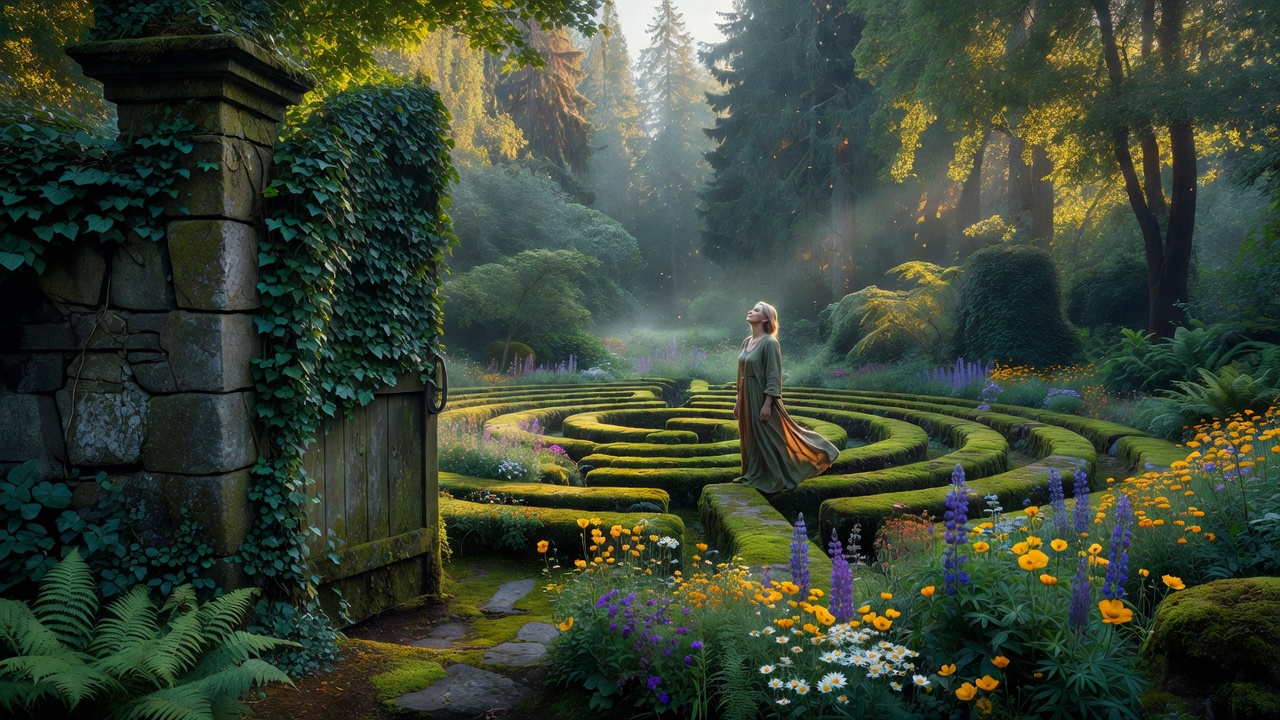
Portland keeps its best secrets behind the most ordinary doors. I learned this on a morning walk through a neighborhood I did not know, when a small ivy-covered gate, slightly ajar, caught my eye. Behind it, tucked between two old buildings, lay a labyrinth garden: mossy stone paths folding back on themselves, wildflowers spilling over the edges, sunlight filtering through a canopy of trees. I stood at the entrance for a long moment, and I felt something I did not expect. I felt afraid. That fear surprised me. I have spent my life as an explorer: charting constellations, reading birth charts, chasing eclipses across state lines, always following the next horizon. I have climbed to the top of Rocky Butte before dawn just to watch the city wake up. I am not afraid of the unknown. But a labyrinth is not the unknown. It is the one map an explorer dreads, because it promises no destination we
have not already seen. It only promises the way back. A Gate That Was Never Locked The gate was not locked. It was not even latched. That should have made it easier, and somehow it made it harder. An explorer is trained for locked doors: we carry keys, tools, cleverness. An open door offers nothing to conquer. I pushed it anyway, because curiosity has always been stronger than my caution, and stepped onto the first stone. Here is the difference between a maze and a labyrinth, and it is a difference that matters. A maze is full of choices: dead ends, wrong turns, the thrill of being lost and the satisfaction of finding the way out. A labyrinth has only one path, and that path keeps folding back on itself. There is nowhere to get lost, and nowhere to escape to. For a person who has built an identity on the next adventure, that is the most unsettling architecture in the world. I walked it
anyway, because the stones were warm and the garden was quiet, and I wanted to know what a path that goes nowhere feels like under my feet. The Center Is Not the Point The center of the labyrinth turned out to be a small clearing with a wooden bench and a carpet of moss. No treasure. No view of the mountains. No plaque explaining the meaning of it all. Just stillness, and the sound of the city reduced to a distant murmur, and light moving through the leaves. I sat down, and I stayed there for longer than I expected. For someone whose whole life is organized around what comes next, standing still at the center of something is the hardest work there is. I see this in my astrology practice constantly: clients come to me asking what happens next, what the next transit means, where the next chapter begins. We treat the chart like a road map, and we forget that the sky keeps returning to the
same houses, year after year, and that wisdom was never in the arrival. It was in the returning. I remembered the northern lights I saw from my own backyard last year. I had chased that vision in my imagination for decades, picturing it over mountains and fjords, and then one evening it simply arrived while I was sipping tea on the porch: green and purple bands dancing over the rooftops of Portland. The wonder had been here all along. The center of the labyrinth taught me the same lesson. You do not have to travel to find the treasure. You only have to stop walking long enough to notice you are standing on it. Walking Out Is Walking In Eventually I stood up and walked out, and this is where the labyrinth did its quiet work. The way out was the way in: the same stones, the same turns, the same wildflowers. And yet it was a completely different walk, because I was a different walker. I had
arrived at the gate carrying my questions about where to go next. I left carrying something closer to gratitude for where I already was. A birth chart is a labyrinth. It is fixed at the moment of birth; the placements never move. And yet I have read the same chart for the same client ten years apart and found rooms I had never seen before. The map did not change. The walker did. I am coming to believe that this is the entire art of astrology, and the entire art of growing older: learning to walk the same path as if it were the first time, because in every real sense it is. Home as a Direction My explorer shadow has always been restlessness. I have left good things early, and I have confused motion with progress, and I have told myself that staying is a kind of failure. The labyrinth garden asked me to reconsider. Home does not have to be the opposite of adventure. It can be a direction:
a gate you keep walking through, a street you keep walking deeper into, a sky you keep studying until it gives up its lesser-known constellations. I have been offered a collaboration with a renowned astrologer on exactly that: the myths of constellations most of us never learned to name. It is the same sky I have been reading for thirty years, and it still contains worlds I have not visited. That is what the garden taught me. Depth is a kind of travel, and returning is not stagnation. It is the bravest route an explorer can take. I have not told anyone exactly where the garden is. Some journeys are best made alone, and some gates are best left a little hidden. But I will tell you this: it is in Portland, it is behind an ivy-covered gate that is never locked, and the path goes nowhere. That is exactly why you should walk it. Closing Reflection I left the labyrinth garden the same person
who entered it, and that is the point. The explorer's true work is not finding a new path. It is walking the old one with new eyes, and trusting that the center will still be there, mossy and patient, waiting to show us what we have been standing on all along. The gate is still there, behind the ivy, unlocked. The path is still there, going nowhere. I think that is the most adventurous place I know, and I will keep going back, the way the moon keeps returning to the same sky, to walk it one more time as if I had never seen it.