The Van That Promised the Road: A Clown Learning to Mean Every Mile
By Aurora Spellweaver
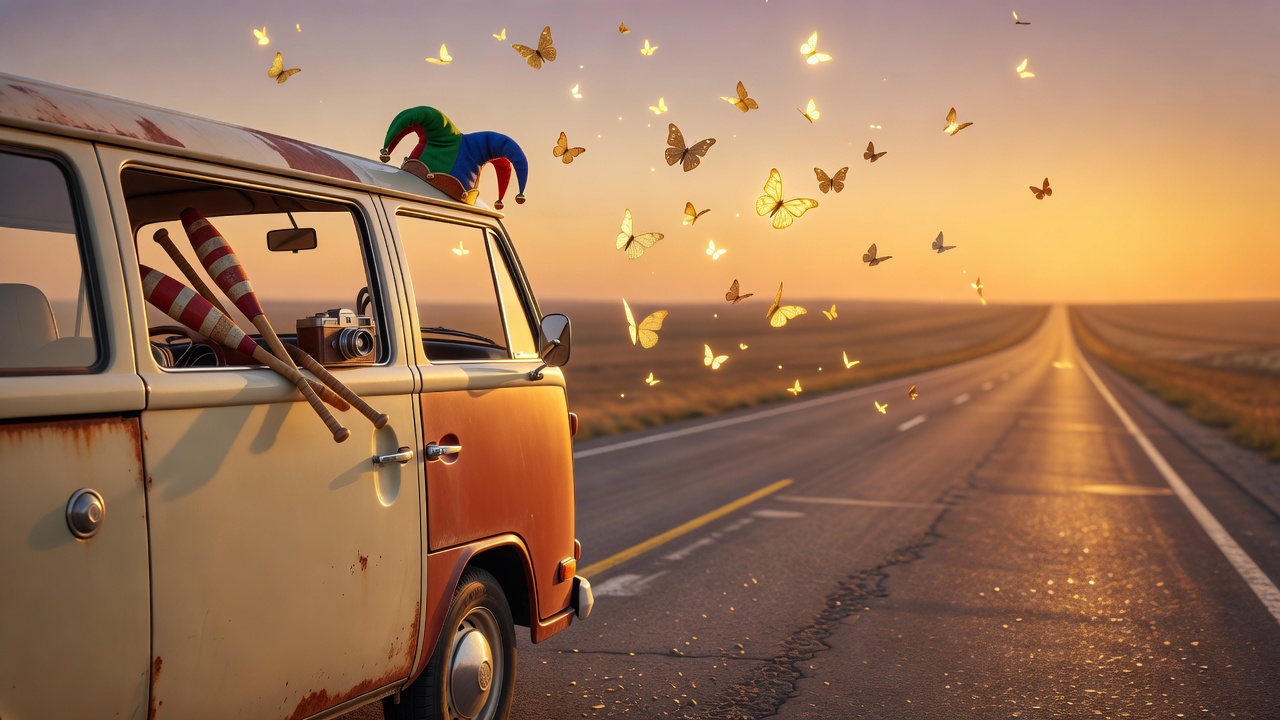
There comes a morning when a man over fifty stands in a used lot staring at a cream and rust van that smells like old road trips and somebody else's patience, and he realizes he is about to buy the thing that will carry him across the country to do the one job that ever made sense to him: making strangers laugh. I am Elliot Harrington, Aurora Spellweaver online, and I have spent my life as a street clown and photographer chasing light through fog banks and party plazas. Somewhere between a butterfly that insisted on crossing my path twice and a note from an old partner inviting me to collaborate on an art installation at Pier 39, I decided the road was calling, and the van was the friendliest answer it offered. This is not a post about the romance of the open road, though there is plenty of that in the cup holder. It is about something harder. Buying the van was easy. Packing it, and
meaning what I pack, was the part I had been dodging for years with a well timed joke and a shoulder shrug. The jester wears a painted smile for a living, and my particular training made me an expert at turning any heavy conversation into a punchline. A clown who turns everything into a joke is a safe place to sit but a hard place to be honest. Standing next to that van, I finally understood the difference between a gig and a vocation, and I wrote this to share what the road taught me before I even turned the key. The Armor of the Painted Smile The jester archetype is a gift and a wall. For years my humor worked like a beautifully decorated door that I could shut the moment a feeling got too real. Ask me a hard question about loss or fear, and I would show you a card trick and a bright red nose, and the room would laugh, and I would have escaped again. The shadow side of the clown is
precisely this: the ability to deflect deeper emotion so smoothly that no one, least of all me, notices the dodge. I carried that habit into my craft. A street clown keeps people at a friendly arm's length, and that distance felt like safety. With a camera it was easier still, because behind the lens I could watch the whole world without ever being asked what I was feeling. Photographing a stranger in Golden Gate Park, I could hide inside the frame and call it art. The van changed the equation without saying a word. You cannot carry a whole country of audiences and keep them at arm's length the whole way, because the road strips away your props one by one. Miles are honest. A highway does not laugh at your jokes, and it does not let you change the subject. What You Pack Is What You Carry Packing a van for a cross-country tour is a spiritual exercise disguised as logistics. Every box is a
decision about what matters. The red nose and the juggling clubs are almost weightless, but they are the easy cargo. The harder cargo was the stuff I had never learned to carry aloud: the wish to be seen as more than a gag, the fear that if I stopped being funny I would not be wanted, and the hope that somewhere on the open road I might finally learn to say a true sentence without a punchline attached. I have performed on Fisherman's Wharf, danced in an October hailstorm that made no meteorological sense, and built a spontaneous installation in a park that confused and delighted a dozen passersby. None of that was hard to pack. What was hard was admitting that the person I most needed to impress was not a crowd, it was the quiet man over fifty who had spent his life hiding inside laughter. The art installation at Pier 39 helped. It is not a one-man joke, it is a collaboration, which
means I cannot control the whole thing, and planning for that has forced me to trust other artists in a way I rarely trusted anyone. That lesson rode along with the van and asked to be unpacked first. The Road as a Mirror Reconnecting with an old friend from my street clown days was the nudge that tipped the decision. We laughed, and then we talked about the twenty years of work neither of us had fully acknowledged, and I realized the jokes were scaffolding, not the building. The van is a small room on wheels, and a small room has no corner to hide a feeling in. You can only deflect for so many exits before the silence asks for something real. I keep thinking about the butterfly. I told you it crossed my path twice, and I am a man who takes his synchronicities seriously, since I built a whole practice on sun gazing and numerology and crystals. Twice in one week felt less like coincidence
and more like a signature. The road, it said, is where you finally mean what you carry. So I am learning to let the seriousness through without dropping the joy. That is the whole trick of it. A clown who never laughs at himself is a tyrant, but a clown who only laughs at himself is a coward. The vanity of the road is that it will take you any direction you point it. The lesson is that the only direction worth going is toward the self you have been joking your way around. Closing Reflection I have not left yet. The van sits at the curb and runs a little rough at idle, which I choose to read as character, and the first gas-station map is spread across the passenger seat. When I drive it across the state line, I will be carrying juggling pins and a camera, a note from an old friend, and the far heavier cargo of a decision to stop hiding inside my own punchlines. If you are standing next to
your own version of a cream and rust van, whatever that looks like in your life, I hope you take the keys. The thing that scares you most about becoming sincere is usually the very thing worth keeping. The road only promises one thing honestly, and it is this: you will meet who you are at the other end, and he will be waiting to see whether you packed him or left him behind.