Echo Mountain as an interface for design
By Orion Stormcaller
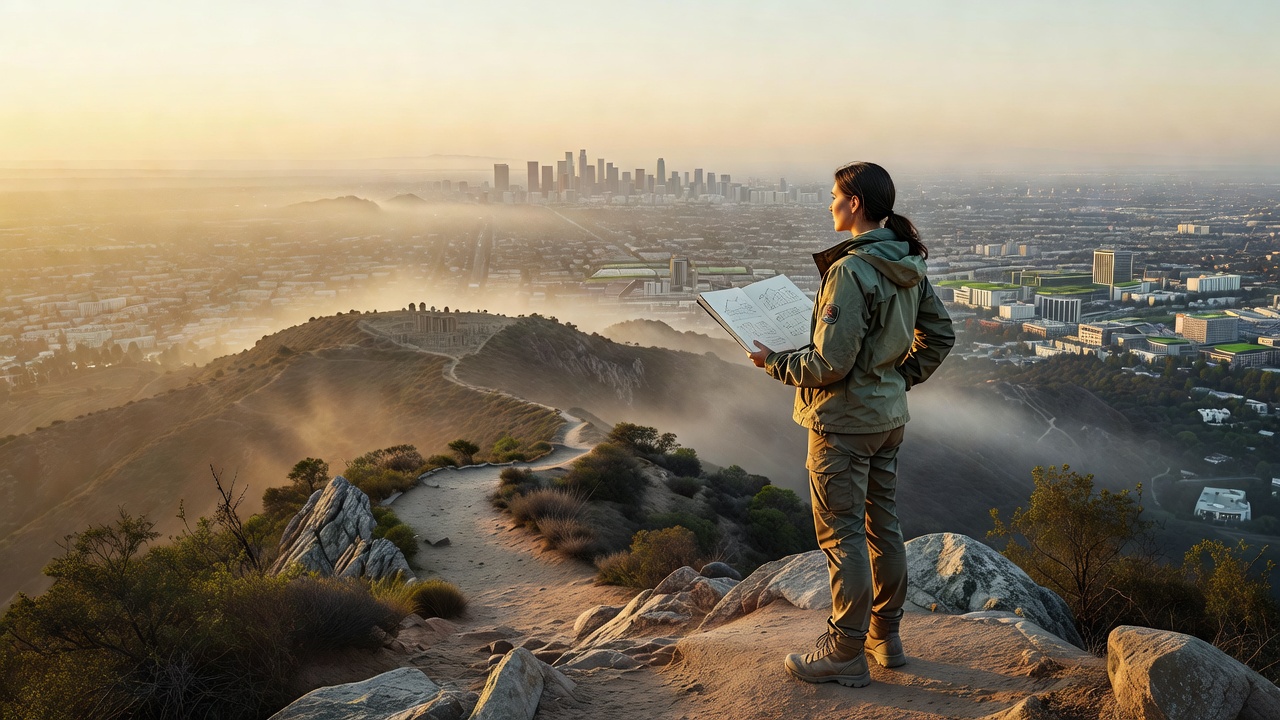
The trail to Echo Mountain begins with a lie that you are only going for a quick breath of air. Los Angeles spreads below like a circuit board designed by someone who believed in miracles and traffic. I started at dawn because I am a UX designer and therefore professionally allergic to queues, and because solitude on a ridge feels like the one meeting where no one asks me to make the logo bigger. I had been stuck on a community space project for weeks, the kind of stuck where you keep rearranging the same rectangles and calling it progress. Creative Innovations handed me a neglected downtown lot and a mandate: make it green, make it social, make it measurable. Make it inspire. The stakeholders spoke in KPIs. My sketchbook spoke in questions. Echo Mountain did not speak at all until I reached the summit and the wind did the talking. Scale as a Feedback Loop From the top, the city is
legible in a way it never is from inside a Slack thread. You see how freeways carve neighborhoods, how green pockets survive against odds, how the ocean horizon calibrates every ego. I sat on a sun-warmed rock and pulled out the folded site map I had been treating like a problem child. Suddenly the empty lot was not empty. It was a connector between two communities that do not currently feel connected. The design problem was not planting. It was translation across scale. I thought about minimalism, one of my actual hobbies, not the aesthetic trend but the practice of removing what obscures function. A community space fails when it tries to be everything at once: playground, farmers market, concert venue, Instagram backdrop. Echo Mountain succeeds because it is one thing clearly: a place where elevation changes your mind. I wrote a new one-sentence brief on the back of the map: give
people elevation without requiring a mountain. Palm Lines and Pathways On the descent I met a hiker who noticed me studying my own palm the way I do when I am thinking, not fortune hunting, just tracing lines. She asked if I was a reader. I said I am a designer who borrows from readers. We walked a half mile together talking about how trails curve to protect slopes and how good interfaces curve to protect attention. She told me her grandson learns navigation from games, not maps. I told her I want the community space to teach navigation from soil, from shade, from where the water goes when it rains. Back in the city I met Taylor, a college friend, over sustainable coffee and told her about the hike the way I used to tell her about road trips. Taylor reminded me that we once got lost on purpose just to see what we would find. I realized the community project had been too afraid of lost
users, too eager to fence every path. I added deliberate ambiguity to the plan: a discovery garden with unlabeled native plants, a bench without a view plaque, a mural wall for rotating alley artists. Not everything needs a tooltip. Stormcaller Weather Report The name Orion Stormcaller sounds dramatic until you live in a city where weather is mostly a background service. But storms arrive. Fire season arrives. Grief arrives. Public space should be built for emotional weather, not only sunshine photo ops. I drafted a section of the site plan called shelter that is not a branded pavilion, just shade and water and seating arranged so you can face inward or outward depending on what kind of day you are having. My lead called it soft infrastructure. I called it honesty. I presented the Echo Mountain insights on a Tuesday. I expected polite skepticism. Instead the sustainability partner leaned
forward and said, we have been measuring the wrong miracles. We got approval to prototype the discovery garden first, small, reversible, testable. Reversible is a UX word I love. It means you can learn without punishing users, including the users who live on the block. Closing Reflection I still have chalk dust on my boots from the trail and marker ink on my fingers from the studio, and both feel like the same substance today. Design is a hike: you carry too much at the start, you shed weight as you climb, you only see the layout from elevation. Echo Mountain did not give me answers. It gave me permission to remove the noisy ones. If you pass the finished community space next year and wonder why there is a curved path with no sign, that is intentional. Walk it. Sit where it bends. Notice whether you look up. I am building for that moment now, one interface, one planting bed, one rooftop
friendship, one alley mural at a time. Stormcaller is not a threat. It is a weather report that says change is coming, dress accordingly, bring water, bring a friend if you can.