What cooking taught me about spiritual practice
By Aldebaran Oracleborn
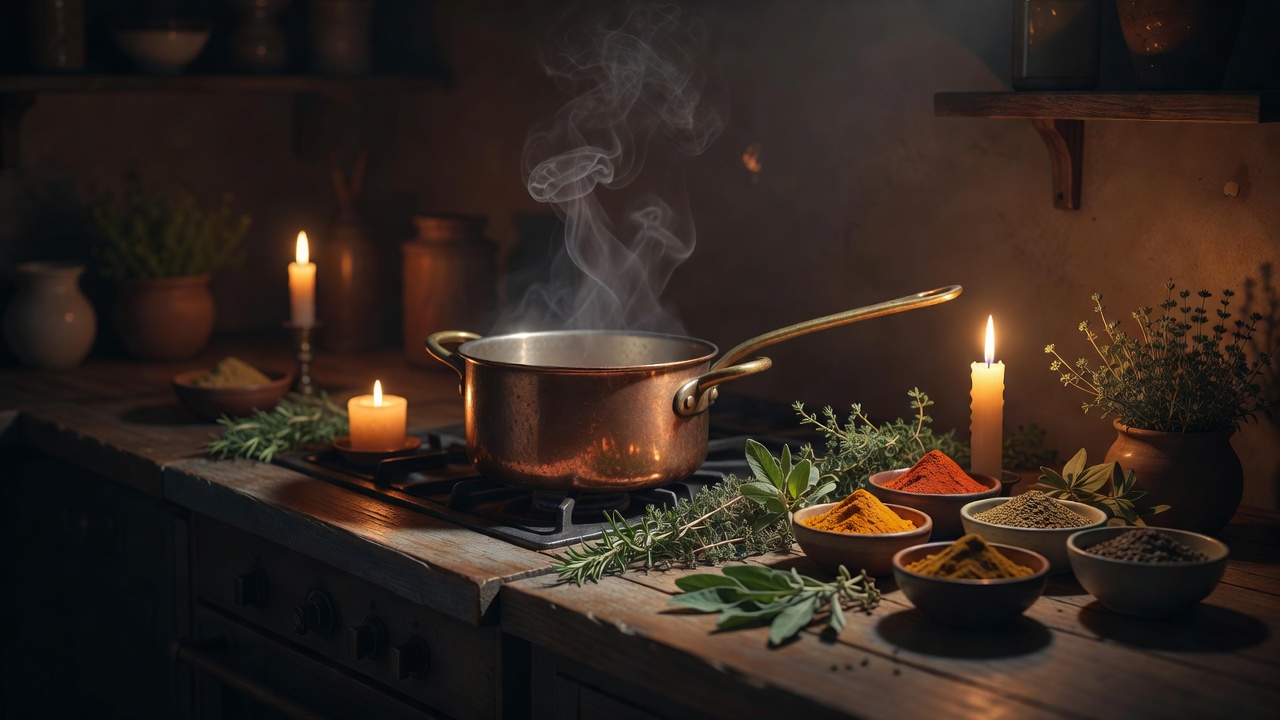
I have a spiritual practice. It involves the Tree of Life and fixed stars and decades of accumulated reading. I also have a spiritual practice that involves olive oil, a heavy-bottomed pot, and a willingness to stand still for an hour while something slow-cooks itself into being. I know how that sounds. Kitchen mysticism is a genre with its own problems — a tendency toward sentimentality, a way of dressing up a hobby in metaphysical language it hasn't necessarily earned. I am not interested in that. What I am interested in is something more specific: the particular quality of attention that cooking demands, and what that quality of attention has in common with the attention I try to bring to more explicitly contemplative practices. They are more similar than I expected when I first noticed the connection. And noticing the connection has made both better. The Problem of Being Present Most
spiritual traditions place a high value on present-moment awareness. The instruction is deceptively simple: be here, now, fully. Stop rehearsing the future and replaying the past. Attend to what is actually happening. This is easy to understand and genuinely difficult to practice. The mind that sits down to meditate is a mind that has spent years elsewhere — planning, worrying, constructing narratives, managing impressions. You cannot simply decide to be present and find yourself there. You have to practice arriving. Cooking, I have found, is one of the more effective ways I know to practice arriving. Not because it is relaxing — it is often not — but because it is demanding in a specific way. It requires you to track multiple things simultaneously: temperature, timing, texture, smell, the behavior of fat and liquid and starch and heat interacting in real time. If your mind drifts
significantly, something burns. The feedback is immediate and honest. This is different from the feedback of meditation, which is often delayed and ambiguous. In the kitchen, presence has immediate consequences. That changes the quality of the effort. Alchemy and the Transformation of Matter The alchemists — and I mean this partly literally, partly as a useful metaphor — were interested in transformation. The idea that matter, worked on skillfully and with the right understanding, could be changed into something of higher quality or greater refinement. Gold from lead, in the popular formulation. But the deeper alchemical literature is clearly about something else: the transformation of the practitioner through the work itself. Cooking is transformation. Raw ingredients become something neither of them was before. Onions caramelize. Collagen in cheap cuts of meat breaks down over hours
into gelatin, turning something tough and cheap into something rich and yielding. Bread dough — flour, water, salt, wild yeast — rises and becomes a living structure before heat sets it into form. These are not trivial changes. They are genuine transmutations. I am not saying that making lentil soup puts you in the company of Paracelsus. I am saying that the basic operation — applying attention and skill and heat and time to raw material in order to create something of greater worth and nourishment — is the same operation, on a different scale, with different stakes. The kitchen is a laboratory in the oldest sense of the word: a place of labor, of working with matter. There is something that happens when you understand a recipe well enough that you no longer need to follow it step by step — when you understand what each step is trying to achieve and can make adjustments in real time
based on what you observe. That understanding is not merely technical. It is relational. You develop a relationship with the ingredients, with the process, with the specific equipment you use. That kind of intimate knowledge is exactly what the esoteric traditions are trying to cultivate in relation to the inner life. Repetition as Practice One of the things I have come to value most about cooking is its repetitiveness. I make the same dishes over and over. Not because I am uncreative but because repetition is how you actually learn something rather than just doing it. The first time you make a dish you are managing the anxiety of the unknown. The second time you are consolidating basic procedure. By the tenth time, something else becomes possible. You are no longer thinking about the steps; you are thinking about the dish. About what it wants. About how the balance of acid and fat and
salt could be adjusted. About what you want it to become. This is exactly the structure of contemplative practice. You sit, you meditate, you return to the breath or the visualization or the mantra — not to have a new experience each time but to wear a groove, to make the return easier, to practice the gesture of attention until it begins to become available outside of the formal practice context. The Zen traditions understood this. There is a reason the monastery kitchen was not considered a lesser domain than the meditation hall. The cook — the tenzo, in Japanese monastic tradition — was often a position of great spiritual responsibility. The labor of preparing food for a community, done with full attention and care, was understood to be practice in the fullest sense. Slowness as Resistance There is also something in the pace of real cooking — not the five-minute hack but the soup that
takes three hours, the bread that takes two days, the stock that needs the whole afternoon — that is worth naming as resistance. Resistance to the dominant pace of contemporary life, which optimizes for speed and output and the elimination of anything that cannot be accelerated. Cooking slowly cannot be hurried without becoming something else. The Maillard reaction that creates flavor in browned meat requires time at the right temperature. Rush it and you get grey, steamed protein. The slow caramelization of onions cannot be speeded up without burning them. You can turn up the heat but you will get something different and worse. This is also true of inner development. There is no accelerated program for becoming more patient, more present, more capable of genuine attention. You have to do the work at the pace the work requires. You have to sit with the discomfort of not-yet-knowing for
as long as that takes. In a culture that sells transformation in weekend workshops and ten-step programs, there is something genuinely countercultural about practices that insist on their own pace. Slow cooking is one of those practices. So is contemplative prayer. So is learning to read the sky. They are all, at bottom, practices in the same virtue: the willingness to be present for a process whose outcome you cannot control and whose timeline is not yours to determine. Closing Reflection I am not trying to make cooking into something it is not. It is practical. It is nourishing. It is sometimes tedious. The onions still make me cry. The timing still goes wrong. But on the nights when everything aligns — when the kitchen is quiet and the smell is right and I am fully present in the doing of it — I recognize something I have felt in meditation and in the best moments of ritual practice.
A quality of attention that dissolves the distance between the person doing a thing and the thing being done. That is worth paying attention to. That is worth cultivating wherever you can find it, including at the stove.