The Cartography of Dreams: How Lucid Dreaming Became My Greatest Expedition
By Aldebaran Pathfinder
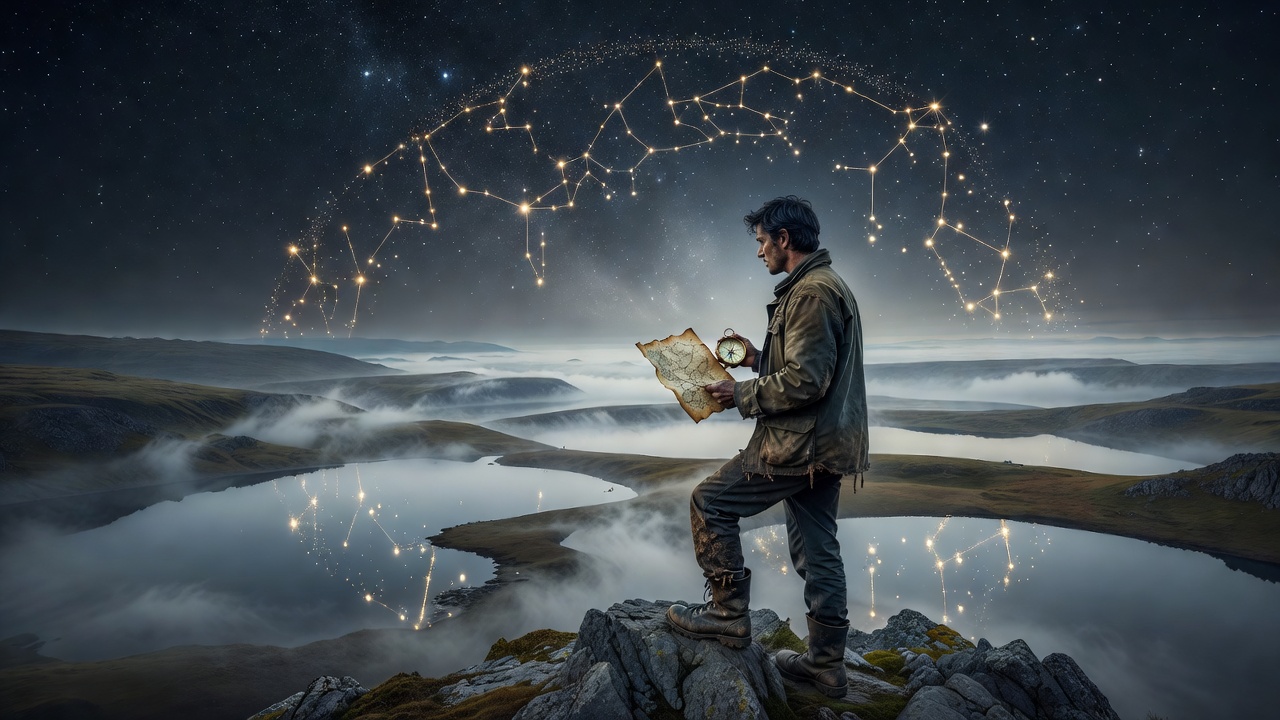
I have spent most of my twenty-three years looking outward. Hidden caves behind waterfalls, abandoned observatories in the woods, a rumored lost city I mapped across a dozen journals. Every horizon was a question, and I believed the answers lived somewhere beyond it. Then one night, after a meteor shower so clear it felt like stepping into a dream, I understood that I had been ignoring an entire continent. Not out there. In here. The landscape behind my closed eyes, where I already spend a third of my life and never once stopped to explore. This is what lucid dreaming taught me: the explorer who only travels by daylight misses half the map. Rest was never the opposite of the search. It was another way to search. The Map I Never Thought to Draw My archetype, if I am honest, carries a shadow. I overcommit to meaning before I rest. Every find had to be decoded, catalogued, cross referenced.
The lost city's map could not wait until morning. The artifact's inscriptions kept me up past midnight. I treated sleep as an interruption to the expedition, a necessary shutdown between discoveries. But an explorer who refuses rest eventually loses the map. I noticed it the hard way: after too many nights forcing the symbols to make sense, the symbols stopped speaking. The meaning I chased so hard went quiet, the way a trail overgrows when no one walks it gently. I was overworking the one instrument that could have guided me, which was my own rested mind. Lucid dreaming forced me to sit with that habit. The moment I became aware inside a dream, I was standing in a territory no compass could read, and my first instinct was still to analyze it, to find its meaning before I let myself simply be there. The dream, patient as the sea, kept offering the same lesson: you cannot chart a place
you refuse to rest inside. Decoding the Dream's Inscriptions I know something about decoding. I spent a summer translating the artifact's carved symbols, convinced each mark held a single correct answer. Lucid dreaming humbled that certainty. Dream images do not decode the way an inscription does. A falling star, a locked door, a river that runs uphill: these are not ciphers with one solution. They are living symbols that change meaning depending on where you stand. The trick I finally learned was to stop treating the dream as a puzzle to solve and start treating it as a place to visit. In waking life I would never force a hidden cave to explain itself before I walked inside. So why did I interrogate my own dreams the moment I recognized them? The explorer's real skill is not decoding. It is showing up without demanding that the meaning arrive first. There is a freedom in that surrender.
When I stopped asking the dream what it meant and simply walked its streets, the meaning came on its own, the way the lost city's name surfaced only after I stopped forcing the map to confess. Some things will only speak to a listener who has put down the tool. The Observatory in the Woods There is an abandoned observatory I found on a hike once, its dome rusted open to the sky. I remember thinking the person who built it understood something I was still learning: you do not chase the stars, you make a quiet place and let them find you. That night's meteor shower, the one that felt like a dream, was the sky doing exactly that. Lucid dreaming became my inner observatory. A still point in the middle of the night where the images of my own mind could pass overhead, bright and unhurried, without me lunging to catch them. Rest, I discovered, is not the absence of exploration. It is the
observatory where exploration finally gets a chance to see. When I stopped chasing the stars and simply sat beneath them, the sky gave me more than any pursuit ever had. The same is true of dreams. They are not a puzzle that rewards force; they are a sky that rewards stillness. That is the quiet secret at the center of every map I have ever drawn. Closing Reflection If you have ever woken from a dream that felt more real than the morning, you already know the territory exists. You do not need special gifts to enter it. You need only the same curiosity you bring to any road you have never walked, and the patience to sit in the dark without demanding a destination. The map of dreams is drawn in sleep, but it leads somewhere in waking life. I am still a soul wanderer. I am only learning that the most important expeditions sometimes begin the moment I close my eyes.