The Second Take: What the Desert Camera Showed Me
By Sol Runemaster
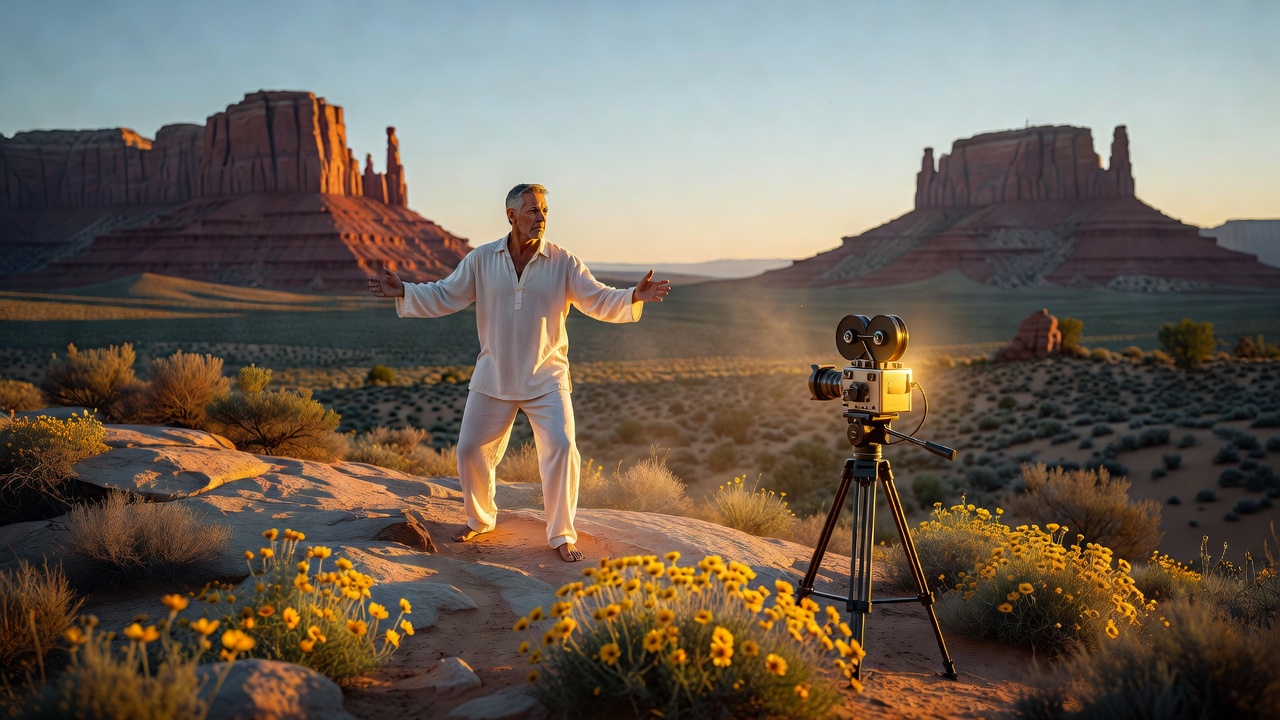
I have practiced Tai Chi in my backyard at dawn for fifteen years, always alone, always in the open air. The desert has been my only witness, and I have never minded. So when an old friend called with a commission to film a Tai Chi video under the desert sky, I said yes before I understood what I was agreeing to. He is a filmmaker. We had not worked together in years. The project sounded simple: move well, look peaceful, let the camera do its work. It was not simple. The camera changed everything about how I moved, and the desert, patient as ever, waited for me to notice. The Fear I Did Not Know I Carried The first morning we set up on a ridge above Santa Fe, I could feel the lens on me the way you feel eyes in a crowd. My arms went tight. My breathing, which I have trained for decades, went shallow. I was performing, and performing badly. My friend said nothing at first. He just kept
rolling, and I kept moving like a man being graded. It took me a while to name what was happening. I wanted the video to be perfect because it would be seen. I wanted proof that my practice was real, that the years had amounted to something a stranger could watch and admire. That is a heavy thing to lay on a sunrise. The part of me that still believes everything will turn out fine if I just try hard enough had decided that the camera was a judge. The Desert Does Not Perform On the second morning, before the light was ready, I walked out to warm up and found the aftermath of the rain that had fallen overnight. The desert had bloomed. Small yellow flowers everywhere, petals holding water that caught the sun. Nothing in that bloom was trying to impress anyone. The flowers did not know a camera existed. They simply opened because it was their time, and the desert, which had looked empty the
day before, was suddenly full of color. I thought about the night I had stood in the same kind of silence and heard coyotes howling in chorus under the stars. They were not harmonizing on purpose, not the way a choir does. They were just answering each other, and the sound carried for miles. The desert does not rehearse. It does not check itself in a mirror. It blooms, it howls, it snows on the red rocks and lets the light do whatever it does. That morning I understood what my practice had been trying to teach me all along: the doing is the thing. The witness is optional. The Second Take I went back to the ridge and told my friend I wanted to try again. He looked at me over the camera and said, good, because the first one was me showing him my practice, and what he wanted was me practicing. I do not know what changed. Maybe the flowers. Maybe the coyotes. But on that second take I
stopped thinking about the video and started doing what I do: I moved the way I move at dawn when no one is watching, slow and soft, letting the form come through me instead of being produced by me. He filmed for an hour and never said cut. When it was over he told me the difference was visible, that I looked like a man moving through water instead of a man being filmed. I told him that was exactly what it felt like. We kept the second take. I have watched it a dozen times since, not to admire it but to remember: the moment I stopped trying to be seen, I was finally worth seeing. What the Camera Taught Me I have thought a lot about what that week gave me. It was never about the video, though the video is lovely. It was about consenting to be witnessed, and finding out that a witness changes nothing about the practice itself. The same lesson has followed me into my sound healing work.
When I hold a singing bowl for someone, I used to wonder if I was doing it right, if they could tell I had practiced alone for years. Now I understand that the bowl does not care. The sound does not perform. It rings, and the ringing is enough. In my chart readings I have started telling people this: you are always being watched by the sun, by the stars, by the desert if you are lucky enough to live near one. None of them are judging you. They are just paying attention. That is a gentler audience than the one we invent in our heads. The camera is gone now, back with my friend. The desert has already erased our footprints. But I still practice every morning, and sometimes, when the light is right, I imagine the lens is there, and I am not afraid of it anymore. Closing Reflection The desert keeps no footage. The wind smooths the sand, the blooms fade, and the coyotes move on to other
hills. Nothing that happened on that ridge is preserved anywhere except in me. That is the real takeaway of the whole commission: the practice was never for the video. It was for the years, and the years were always enough. If you ever get the chance to be filmed doing the thing you love, say yes. Then forget the camera. The sun is the only lens that matters, and it has been watching you all along, kindly, the whole time.