Sharing a name with the star Aldebaran
By Aldebaran Oracleborn
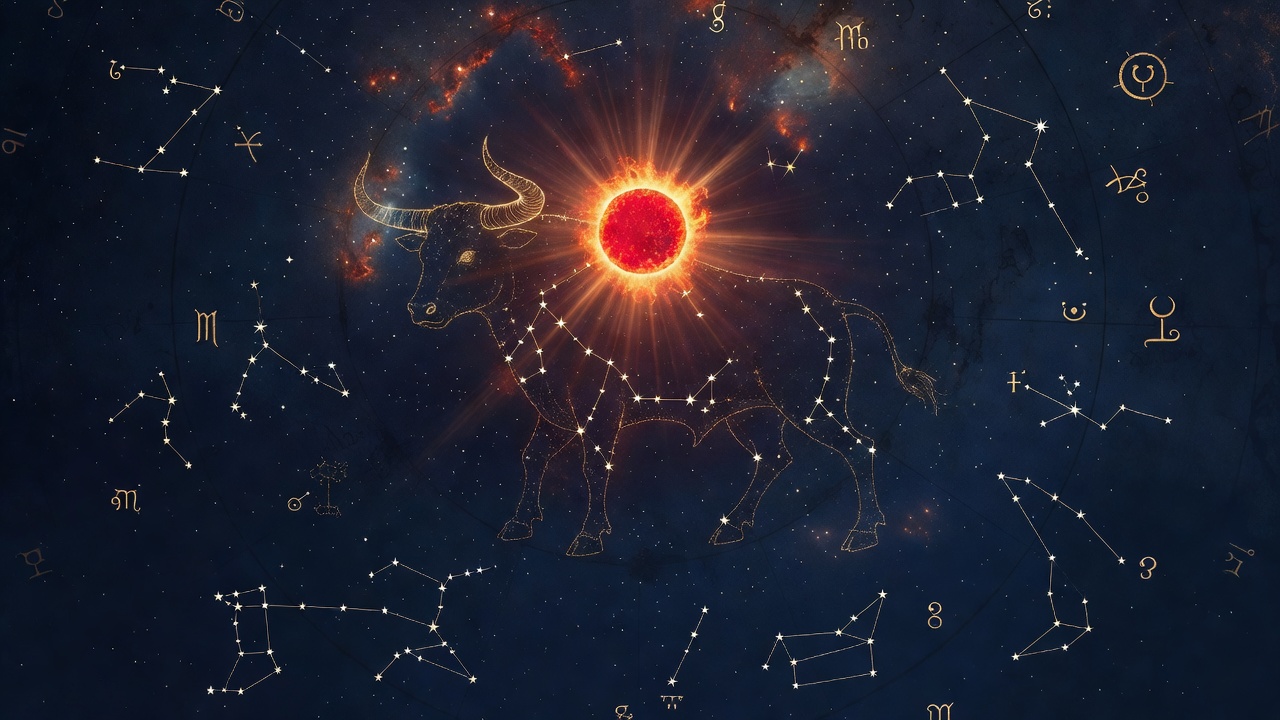
I didn't choose this name. But the more I study the sky, the more I think it may have chosen me. Aldebaran is one of the four Royal Stars of Persia — the Watchers of the Heavens. It sits in the eye of the Bull, at 9 degrees Gemini in the tropical zodiac, a fixed star of the first magnitude. Red-orange, blazing, ancient. The Persians called it Tascheter, the Watcher of the East. It was used to mark the vernal equinox some five thousand years ago. Before modern astronomy had names for most things, this star had a reputation. Growing up, my name was just a name. An unusual one — people stumbled over it, asked where it came from. I never had a good answer. My parents liked the sound of it. But at some point in my early twenties, when I started actually studying astrology and not just reading sun sign columns, I looked it up. And something shifted. The Four Watchers In ancient Persian
cosmology, the heavens were divided into four quarters, each guarded by a Royal Star. Aldebaran watched the East. Regulus watched the North. Antares watched the West. Fomalhaut watched the South. These weren't arbitrary choices — they were the four stars that once marked the solstices and equinoxes, the cardinal turning points of the year. The Watchers were the sky's own calendar. What makes these stars 'royal' is not just their brightness, though all four are among the most luminous in the night sky. It's their placement at threshold moments — the hinges of the year. To stand at a threshold is to occupy a liminal position. Neither here nor there. Watching both directions at once. Aldebaran specifically is associated with integrity and courage. Traditional astrology places it as fortunate when conjunct the Sun, Moon, or Ascendant — but only if you hold to your principles. There's a
condition. The star gives, but it tests. It watches. A Name as a Lens I'm not a mystic who believes every coincidence is a message. But I do think that the names we carry — given to us before we could speak — act as lenses. They shape how others see us. Over time, if we let them, they shape how we see ourselves. When I began introducing myself at community events, at esoteric meetups, in online spaces, people responded to my name differently than I expected. Not confusion anymore — recognition. Oh, the star. Yes. That one. And I found myself living up to something I hadn't consciously signed up for. There is something the astrologers say about Aldebaran: it demands that the person who carries its energy not look away from difficult truths. The Watcher cannot close its eye. I think about that often. In my practice, in my conversations, in the way I try to engage with people who come to me
with hard questions about their charts or their lives. The star watches. So do I. Fixed Stars in Modern Practice Most contemporary astrology ignores fixed stars entirely. We have enough to work with in a modern natal chart — ten planets, the angles, asteroids, nodes. Adding stars that move less than a degree per century can seem like overcomplication. But I've come to believe the fixed stars offer something the planets can't: deep time. The planets tell your story within a human lifespan. The fixed stars situate that story within something much larger. When a fixed star conjuncts your natal Sun to within a degree, you're participating in a pattern that was old before Rome was founded. Aldebaran at 9 Gemini has been sitting near that degree for thousands of years. Anyone born with a planet there — in any era, in any civilization — carries some thread of that archetype. The Watcher. The
threshold guardian. The one who holds the line between seasons. I find that humbling. My name is an accident. The star is not. Closing Reflection I don't claim the star chose me. That would be too easy an answer. But I do think names are worth sitting with — worth researching, worth meditating on. Whatever your name means, wherever it comes from, there is probably something useful in the inquiry. The sky has been watching us long before we started watching it. Maybe some of us are just watching back.