Alley mural that rewired my design brain
By Orion Stormcaller
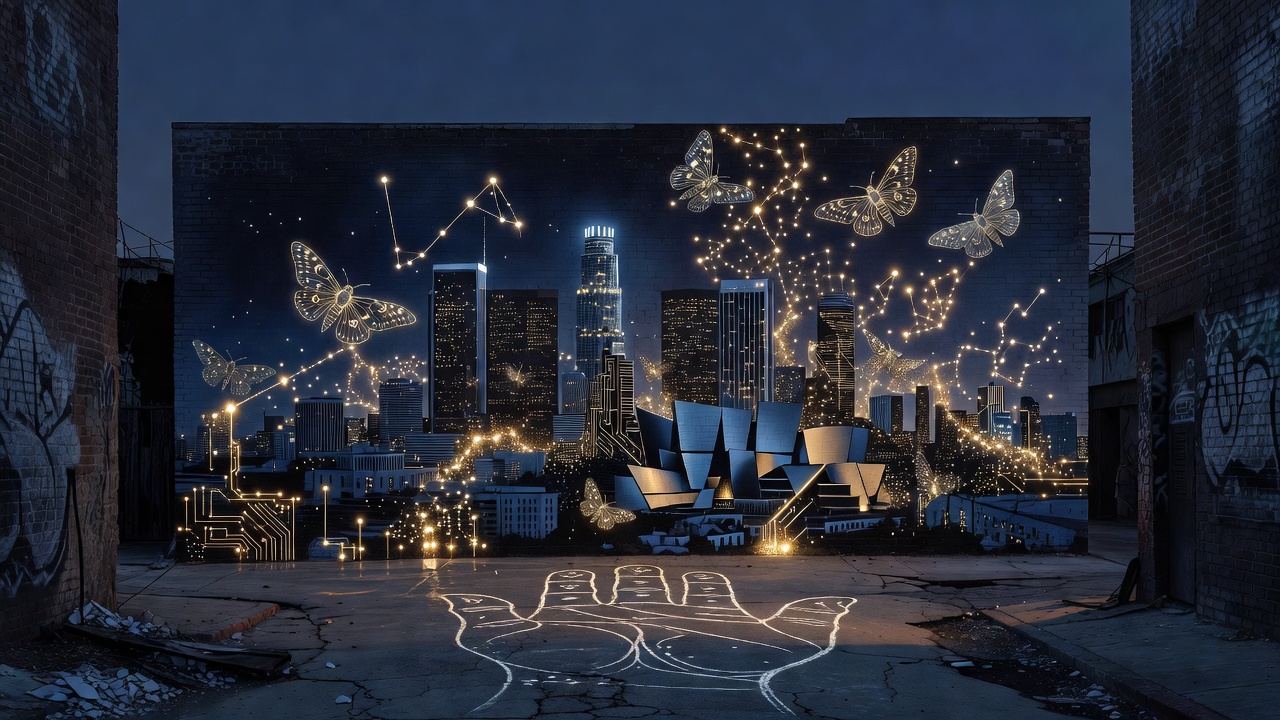
I took the long way to a client review on a Tuesday that felt too ordinary to deserve a story. That is usually when Los Angeles decides to embarrass you with beauty. I cut through an alley I had walked past a dozen times without noticing the narrow gap between a dry cleaner and a plant shop, and there it was: a mural the size of a small chapel wall, painted in deep indigo and molten gold, showing a city skyline dissolving into a star field. Planets hung low over palm trees. Constellation lines threaded through fire escapes as if the buildings themselves were part of the chart. I stood there longer than any responsible UX designer should stand in a random alley, phone in hand, not taking notes, just receiving. The mural did not explain itself. It did not offer a tutorial overlay or a friendly onboarding modal. It assumed you were capable of wonder if you slowed down. I thought about every
interface I had shipped that year, how many of them had begged for attention and still failed to earn it, and how this wall had earned mine in under three seconds without a single notification badge. Navigation Without Hand-Holding The mural's artist understood hierarchy without a design system document. Your eye entered at a crescent moon above a bus stop, traveled along a painted river of light toward a figure reading a star map on a rooftop, and only then discovered the smaller details: moths with circuit-board wings, angel numbers tucked into graffiti tags, a palmistry hand outlined in chalk-white paint at the bottom edge. Nothing was labeled. Everything was discoverable if you were patient. As a designer I spend my weeks arguing about button placement and contrast ratios, but this wall reminded me that orientation can be emotional before it is logical. People will follow a line of
light if they trust where it leads. I photographed the mural, not for social media, though I knew I would post it eventually, but because I wanted to study the composition later. Back at my desk I sketched a wireframe inspired by the piece: a community space landing page that behaved like an alley you wandered into, not a funnel you got pushed through. My project lead wanted a hero banner with three calls to action. I pushed for one luminous path and secondary discoveries hidden behind scroll, the way the mural revealed its moths only after you committed to looking. We compromised, because compromises are also part of design, but I kept the star-map metaphor in the prototype and it survived user testing better than I expected. Cosmos in the Infrastructure Los Angeles teaches you that sacred imagery does not require a cathedral. It can live on stucco next to a dumpster that smells like
rosemary and exhaust. The mural's cosmic themes were not escapist; they rooted the sky in the neighborhood. Orion's belt aligned with a real rooftop water tower I could see from the alley. The painter had done their homework. I felt the same jolt I get when a palmistry client points to a line on their hand and I realize it maps to a decision they are actively avoiding. Pattern recognition is my job in two professions that do not usually share a business card. That night I met Alex at a rooftop star-gazing event, an amateur astronomer who could name fourteen constellations without using an app. We talked about light pollution the way other people talk about bad typography: as a tragedy that obscures meaning. Alex told me most people fail at stargazing because they try to consume the whole sky at once. You need a entry point, a single anchor star, a story. I told him about the mural. He
told me about navigating by Cassiopeia when you are lost. We exchanged numbers. I walked home thinking that friendship, like interface design, works best when you offer someone one clear place to begin. From Inspiration to Deliverable The next morning I opened Figma and created a mood board panel called Alley Chapel. I dropped in cropped details from the mural: the circuit moths, the chalk hand, the river of light. I wrote a note to myself in the margin: wonder is not decoration; it is wayfinding. My eco-friendly community space project, the downtown lot Creative Innovations wants transformed into something alive, suddenly had a narrative spine. We are not building a park. We are building a threshold where people remember they live under stars even when the grid pretends otherwise. I presented the concept to urban planners and sustainability partners with more confidence than I usually
bring to stakeholder meetings. I showed the mural photo first, before budgets and drainage diagrams. I watched shoulders drop. Someone said, I have walked past that alley. Someone else said, I never saw it. We agreed on an installation path that curves, on seating that faces both the street and the sky, on a low-light policy that protects whatever moths still live in this city. The deliverable is still CAD files and planting schedules. The soul of it is that painted wall I almost missed. Closing Reflection I go back to the alley sometimes on purpose now, not only when I am lost between meetings. The mural has faded a little at the edges, because weather is honest about entropy. So am I, when I review analytics and watch people abandon flows I thought were elegant. The work is never finished. The sky keeps moving. What changed is my definition of success. If one person pauses the way I
paused, if one interface makes room for discovery instead of demanding compliance, then the alley did its job and so did I. If you are building something, digital or physical, ask whether it has a single luminous path and a few hidden moths worth finding. Ask whether a stranger could stumble into it on the long way to somewhere else and feel, for a second, that the city is larger than their to-do list. That is the standard I am holding now. Orion Stormcaller is not just a screen name; it is a reminder to design for the moment someone looks up.