The Rainbow Was Not a Shortcut: What the Road to the Lost City Asks of Us
By Aldebaran Pathfinder
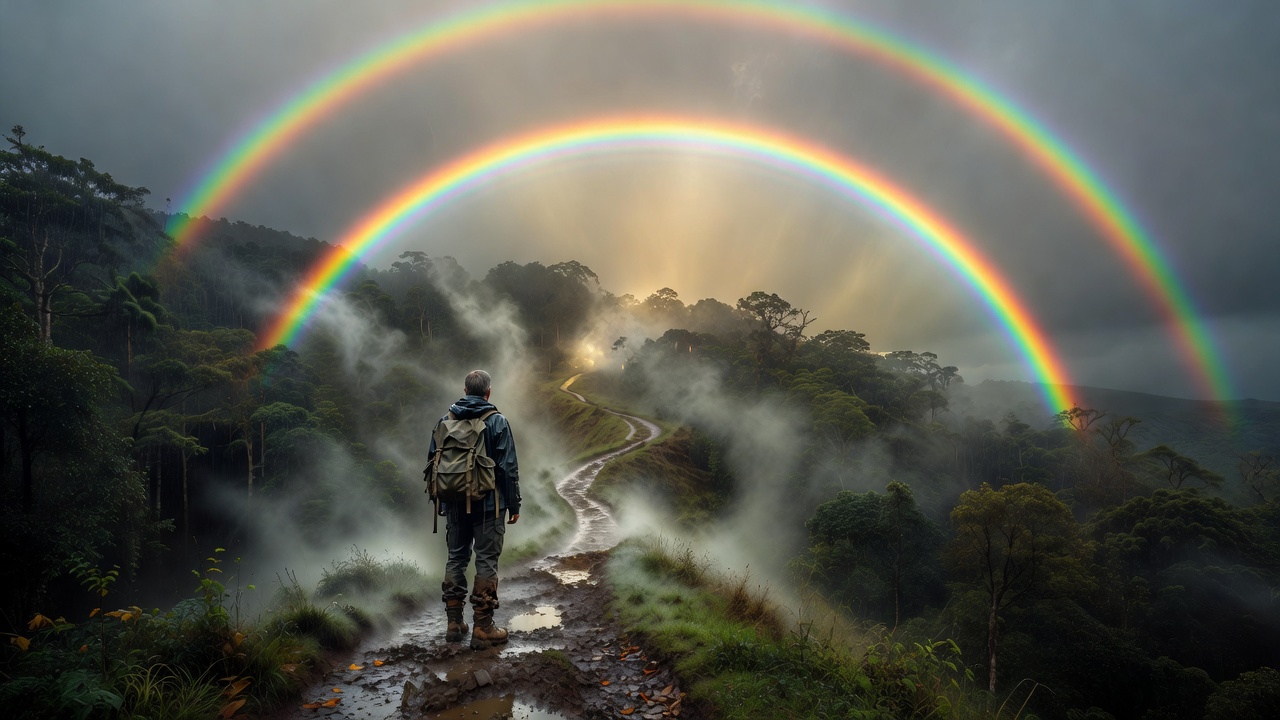
The double rainbow came at the worst possible moment, which is to say the perfect one. I was three hours into a misty forest trek, halfway convinced the map in my pocket was a beautiful delusion, when the drizzle let up and the sky opened into two clean bands of color arching over the canopy. I stood there with rain on my face and did what I always do with a good omen: I walked faster. That is the confession at the heart of this post. For weeks I have been preparing an expedition to find a rumored lost city, a place I first learned about from a map hidden inside a dusty book that fell off a library shelf. I have decoded symbols, studied star charts in an abandoned observatory, and collected every sign the universe has offered: a meteor shower, a cave behind a waterfall, an ancient oak carved with a forgotten story. And somewhere along the way I started to treat those signs as shortcuts,
as if the cosmos blessing the direction meant I did not have to do the slow work of the road. The Omen and the Pace There is a difference between a sign that points and a sign that carries you. I did not understand this until the night of the meteor shower. I was camping near the forest where the city is rumored to sleep, and the sky began to paint stories across the heavens, streaks of light falling so thick I forgot to breathe. In that moment I felt chosen, marked, already halfway to the prize. The feeling lasted exactly as long as the shower. By morning I was cold, tired, and no closer to the city, because I had spent the night staring upward instead of resting, and a tired explorer is a careless one. The omens had not lied to me. They had simply been company, and I had turned them into a command to run. This is the shadow side of my explorer heart. I overcommit to meaning before
rest. Give me a rainbow and I will build a cathedral of interpretation on top of it; give me a coincidence and I will turn it into a destiny. The signs were never the problem. The problem was the pace I kept because of them. So I made a rule for the expedition: when a sign appears, I stop, I thank it, and I check my boots. Gratitude takes a breath. Superstition takes your legs. The rainbow that morning was not telling me to hurry. It was telling me the road was beautiful, which is a different and better message. The Map Is a Conversation, Not a Command The map that started all of this is a strange document. I found it in an old library, wedged between the pages of a book that fell from the top shelf, complete with cryptic notes and symbols that took me weeks to decode. The breakthrough, when it came, felt like a door opening in my chest. I knew exactly where the lost city was, and I have
never been more certain of anything. But certainty is strange fuel. The map confirmed the location of the city, and then it stopped helping. Its ink simply ends at the edge of the deep forest, and the forest goes on being a forest, indifferent to my careful translations. I stood at that edge and understood: the map is a conversation, not a command. It tells you where to begin. It never tells you how to walk. The places that have mattered most on this journey are not on the map at all. The cave behind the waterfall, lit by glowing fungi, was a detour I almost skipped. The ancient oak with its carved symbols sat at the end of an unmarked trail I nearly walked past. The abandoned observatory, its faded star charts still pinned to the walls, was a forgotten room of knowledge that no chart of mine ever promised. I am learning to leave room in my plans for what the plans cannot see. The blank
spaces on a map are not empty. They are the places where the real journey happens, the parts that will not fit inside a symbol. I still carry the map. I just do not let it carry me. Packing for What Cannot Be Mapped The strangest part of preparing for an expedition is how unglamorous it is. I have spent more hours on supplies than on symbols: water filters, boots that are properly broken in, rope, a notebook, a spare pair of socks. The lost city has waited for centuries. It will wait while I tie my boots correctly. This is the lesson the old bookstore owner taught me without meaning to. I found her shop while wandering an unfamiliar part of town, a quaint place full of ancient texts on Theosophy, Tarot, and angel numbers, and she told me stories about the origins of the symbols I had been studying. I left with a rare book on numerology and a quiet realization: she had spent a lifetime
learning, and she was in no hurry to be done. Rest is part of the expedition. That is the hardest thing for me to write, because my instinct is to treat sleep as a delay and stillness as a failure. But the trail does not care how eager I am. It will take what it takes, and I will arrive at the city either tired and honest or frantic and empty. Those are the only two ways in. So I am packing light and resting on purpose. I am asking the people joining the expedition what they carry, because a team is a kind of map too, and I want to read it honestly. The city will still be there. What matters is who walks in, and whether they have water in their pack and peace in their chest. Closing Reflection The double rainbow was not a shortcut. It was a postcard from the road, sent ahead to say: this is what awaits, now walk. The meteor shower was not a promise that I would arrive. It was proof that
the sky is also traveling, and that I am not alone in the dark. I am still weeks from the city. I have a map, a team, a notebook full of symbols, and a hard-won rule about pace. Whatever I find there, I already know the real treasure of this expedition: it is the walking itself, done slowly enough to be lived. If you are chasing a lost city of your own, I hope you pack rest, thank your omens, and leave room on your map for what the map cannot see. The road is beautiful. Do not run past it.