Cranes flying over the healing garden
By Phoenix Fateweaver
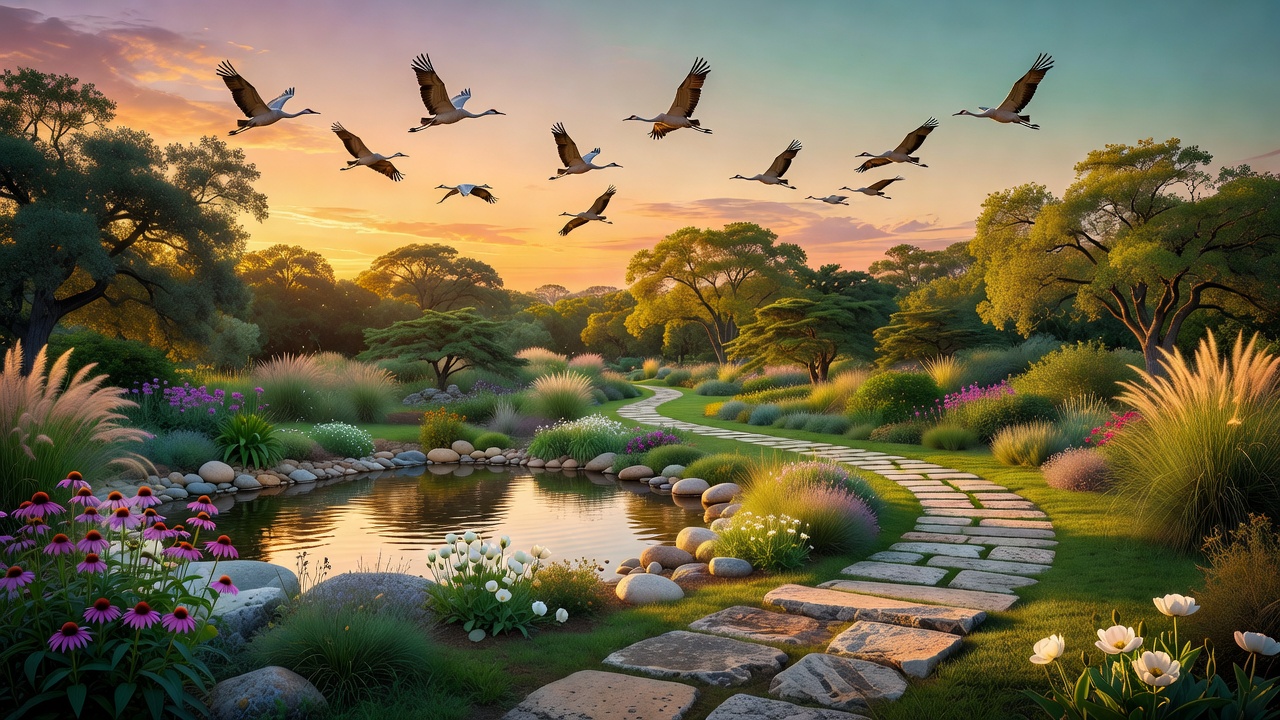
The healing garden began as a sketch on the back of a workshop evaluation form. A participant had written, your voice slowed my nervous system, and I had drawn a spiral pond around the words without thinking. By the time I pitched the idea to the Hill Country Retreat Center, the spiral had acquired meditation stones, a bench facing east, and a border of native salvias I could not yet pronounce correctly. Gardens are like that for me. They start as feelings and only later agree to become plans. Our local horticulturist, Miriam, met me on site with soil samples and the patience of someone who has watched many visionaries confuse enthusiasm for irrigation. She walked the land in silence, then said the water wanted to move left, not right. I had drawn the spiral clockwise. We laughed, moved the pond, and I felt the first honest lesson of the project: caregiving includes listening to what you
did not architect. Austin heat pressed down while we talked, and even the air felt like a collaborator asking for shade. Designing for Nervous Systems A healing garden is not decoration for a retreat center. It is part of the treatment. People arrive carrying stories their bodies still believe. A path that curves slows urgency without preaching. A low fountain masks highway hum. Shade tells the skin it can stay. Miriam insisted on plants that feed pollinators because, she said, people relax when they see something else being cared for at the same time. I wrote that down. It belongs in my coaching manuals now. I host mindfulness circles in the finished section when the weather cooperates. Participants often cry quietly near the water feature, not from sadness necessarily, but from the relief of having a place that does not ask them to explain why their shoulders hurt. As a holistic life
coach I can offer language and practices. The garden offers witness. Together they do what either alone cannot. One man told me the bench facing east was the first place he had prayed without performing prayer. I carry that sentence like a tool. People relax when they see something else being cared for at the same time. The Crane Formation The cranes arrived on an evening when I was alone, staking young milkweed and questioning every decision I had made that week. Sandhill cranes overhead sound like the sky clearing its throat. Their formation was messy-perfect, the kind of coordination that makes you trust patterns you cannot control. I stood still, dirt on my knees, and felt my caregiver shadow loosen its grip. Not everything must be held by me. Some things migrate through without my management. I sketched the cranes in my journal next to irrigation notes. A wellness author who had
praised my nature-integrated meditation approach later asked whether the garden might appear in her book. I said yes, if the cranes get a sentence. She laughed. I was serious. Spiritual practice without wildlife is still practice, but Austin keeps reminding me that the city is a chorus if you stop talking long enough to hear it. That night I texted Miriam a crude drawing. She replied with a single word: exactly. Curve the path so urgency cannot sprint Let water choose its direction Plant for pollinators and people together Leave one bench unlabeled Birdwatching as Spiritual Literacy Days after the crane sighting, I spotted a Painted Bunting on the Greenbelt, a riot of color that felt like the garden's mood made feathered. Birdwatching has become my informal continuing education. Strangers at cafes share sanctuary locations. Seniors at Zilker compare migration timelines. Each exchange is
community building wearing binoculars. I am an ENTP on paper, but my spirit element craves the quiet tally of what arrives when you are paying attention. The garden now includes a small seating area oriented for dawn bird activity. Workshop participants sometimes sit there before breakfast, coffee in hand, saying nothing. Those mornings generate better session questions than any icebreaker I have invented. People ask what they are ready to hear when the world shows them color first. I have started calling it the literacy hour: reading sky instead of screen. Closing Reflection The healing garden is not finished. Gardens teach impermanence by design. What is finished is my understanding of why I needed it: not to prove I can build sacred space, but to share maintenance of a world that heals in cycles, not invoices. Every volunteer shift teaches me the same thing I tell clients: consistency
is a form of love. If you are tending people, tend a patch of ground too, even a pot on a balcony. Watch what flies over. Let the water move left if it insists. Phoenix Fateweaver is a name for the cycle, not the flame. The cranes already knew that. I am catching up, one seedling and one breath at a time.