The Sky Was Never Mine to Keep
By Castor Shadowmancer
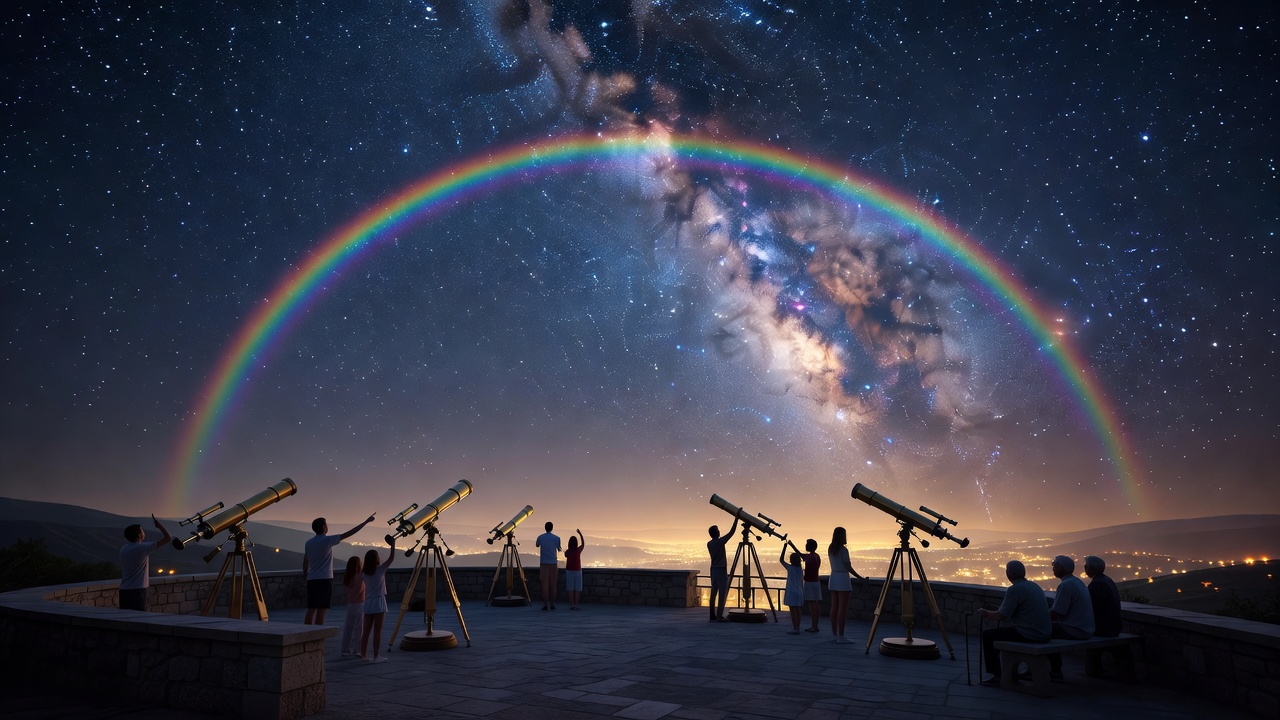
The invitation arrived as an email, and I stared at it longer than I care to admit. The Griffith Observatory wanted me to lead a community stargazing event, open to the public, free, with guided telescope viewings and open conversation. For a man who has spent twenty years collecting constellation lore like rare coins, this should have been simple. Instead, my first honest thought was a question I did not expect: what could I possibly show a stranger that would matter? I have built my life around the sky. I read charts, I teach alchemy workshops, I have written a book about the hidden myths of the constellations. And somewhere along the way, the sky became my territory, my study, my quiet country. The idea of opening that country to hundreds of people felt less like generosity and more like a test I had not studied for. The universe, it turns out, has a sense of humor. It answered my
fear by putting a street musician in my path, a man with a wooden flute and a melody that seemed to breathe with the ocean. The Expert's Trap There is a specific loneliness that comes with knowing a thing deeply. You collect facts the way a house collects dust, and each new layer of knowledge makes the window a little smaller. I could tell you which star marked the eye of a forgotten god on an eighteenth century map, but ask me to simply stand in the grass and look up, and my mind would start solving equations instead of watching. My archetype, if you believe in such labels, is the sage, and my shadow is analysis paralysis. I can talk about the sky for an hour and never once see it. Planning the event forced me to face this. Every detail, from telescope placement to a schedule of which constellations to point at, became a way of hiding inside my own expertise. I caught myself treating
the night as a lecture I had to deliver perfectly, rather than a sky I had the honor of sharing. The Flute Player at Venice Beach Then came the musician. I was walking the boardwalk at Venice Beach, rehearsing my event notes in my head, when a tune caught me mid-step. A man with a handmade wooden flute was playing something slow and searching, and the sound seemed to rise and fall with the waves themselves. I stood there longer than I planned. The melody was not complex. It did not need to be. It simply paid attention to the moment it was in, and that was enough to stop a hundred strangers in their tracks. I realized, standing there, that the musician did not own the music. He had made it, yes, but the moment it left his hands it belonged to anyone who stopped to listen. The ocean did not need his permission to keep time. Neither did the crowd. And neither, I understood with a strange
clarity, did the stars need my permission to mean something to someone else. I had been treating wonder like a language only I could translate. The Night We All Looked Up The evening of the event, I set up the telescopes early and tried to remember my own advice. Families came. A group of teenagers arrived with a half-broken pair of binoculars and zero shame about it. A woman who worked nights at a hospital told me she had never seen the moon through a lens. I stepped back and let the amateurs take the eyepieces first, because they asked better questions than I had in years. The moment I will carry longest was a small one. A child, maybe seven years old, waited in line with impressive patience, and when her turn came she looked through the telescope and went completely silent. Then she turned to her father and whispered, 'It's really there.' Not a lecture, not a chart, not a myth. Just
the plain, staggering fact that the thing she had only seen in pictures was real, and she was looking at it with her own eyes. That whisper did more for my faith in the universe than any treatise I have ever written. We talked about dark skies that night too, about how light pollution is slowly erasing what every human being used to see from their own backyard. The eco-friendly travel magazine that hired me for a stargazing guide calls it sustainable stargazing. I call it remembering that the sky is the last commons we all share, and you cannot love what you have never been shown. A Guide, Not a Gatekeeper I have spent three years writing Stellar Echoes, my book about the hidden myths of the sky, and I thought finishing the draft would be the end of something. Instead, the community event taught me that a book is just another telescope. It points, it focuses, and then it steps aside. The
actual seeing has to happen in someone else's eyes. Since that night, my Tai Chi at Griffith Park feels different. The double rainbow that arched over the skyline after a morning rain, the monarchs that danced around my practice, even the red-tailed hawk that appeared in a sudden gust of wind, all of it reads differently now. Not as signs meant only for me, but as invitations to point and say, look. The universe is not a possession. It is a hand extended. Closing Reflection The Joshua Tree retreat is coming up, and for the first time I am more excited about who will be there than about the itinerary. I still know the charts, the myths, the alchemical correspondences. But I no longer mistake the map for the sky. The sage's real work, I am learning, is not to hoard wisdom. It is to hold the door open and let everyone else see how bright the night can be. So if you ever find yourself at an
observatory, or a beach, or a quiet stretch of desert, do me a favor. Look up. The sky was never mine to keep. It was always waiting for you.