The Blank Places on the Map
By Aldebaran Oracleborn
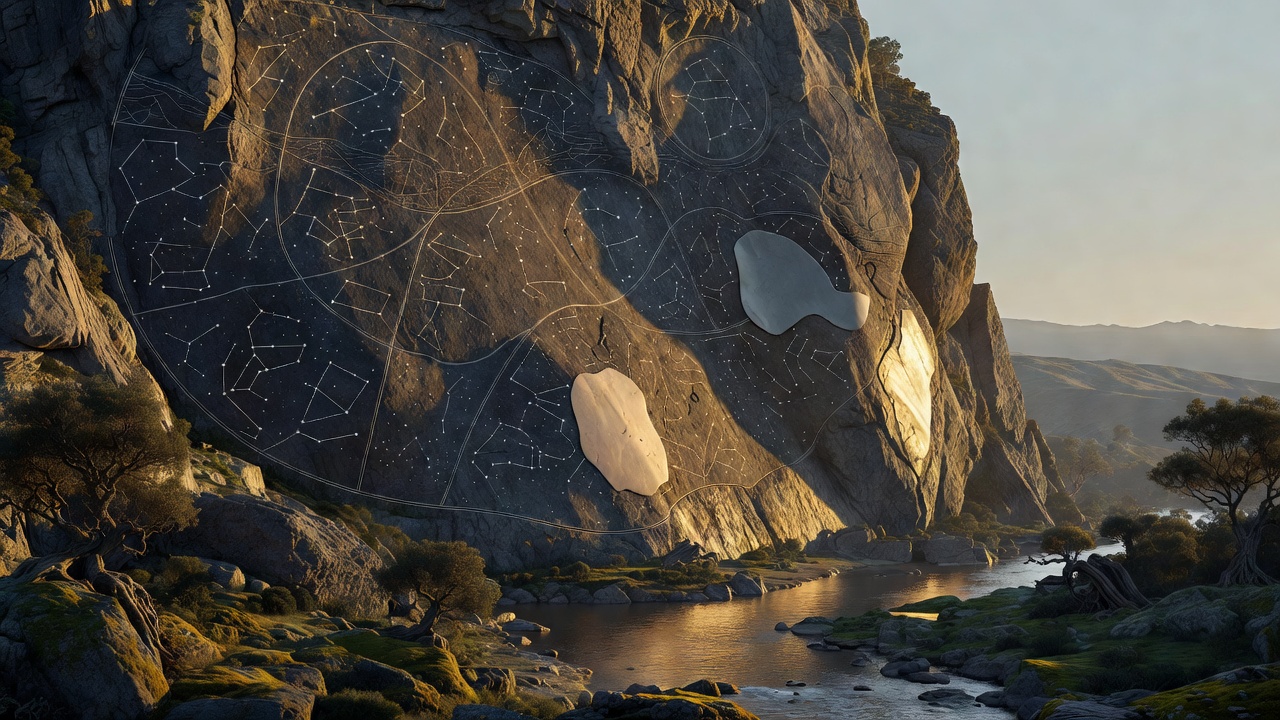
I found the map on a Tuesday, which felt right. Maps have always found me on ordinary days, as if they want to be discovered by someone who is not looking too hard. This one was etched into a cliff face above the river, lines cut deep enough to survive centuries of weather, and when the afternoon light hit it at the right angle, the stars appeared. Not painted stars. Carved stars, arranged in constellations I recognized and a few I did not, with paths drawn between them that no modern chart in my collection could explain. I stood there for a long time with my hands flat on the stone, the way you touch something you are afraid to break. A week later, the museum called. They had heard about the cliff map, and they wanted me to curate an exhibition of ancient celestial cartography. The offer felt like a door swinging open onto a room I had been circling my whole life. I said yes before I
had finished thinking about it, which is exactly the kind of yes that gets me into trouble. The Marks I Couldn't Stop Reading For the next month I lived inside that map. I photographed every inch of the cliff, traced the lines onto vellum, compared them against the catalogs and the old manuscripts I keep stacked beside my bed. The Stellar Lexicon people had written back too, asking for a contribution, and I told them I would deliver something worthy of the map. I wanted to be the person who finally decoded it, who named every star it marked and every route it drew, who turned its silences into answers. That is my particular weakness. I can feel it in my chest when it takes over, the way a fire takes over a dry field. I overcommit meaning before rest. Where another person sees a blank stretch of stone, I see a question I am obliged to answer, a gap I am obliged to fill. I stayed up until
three in the morning for weeks, convinced that if I just looked a little longer, the map would give up every secret at once. The cliff map had other plans. It had large empty regions, smooth stone where no star was carved, where the lines simply stopped. I treated those regions as failures at first, as damage, as places where the weather had worn the truth away. I almost wrote them off in my notes as lost. It did not occur to me that they might be the most deliberate part of the whole composition. The Mapmakers Left It Blank on Purpose The breakthrough came from an old treatise, one of the ones nobody reads anymore, bound in cracked leather and full of margin notes from hands long gone. It described the practice of leaving portions of a sky map unwritten. The author called these places breathing room. The mapmakers believed that a chart was a conversation with the living, not a monument
to the dead, and a conversation needs space for the other voice. The stars shift. The sky moves, slowly and insistently, so slowly that a single lifetime cannot see it but a civilization can. A map that was finished, that claimed to know everything, would be a lie within a few generations. The blank places were how the mapmakers told the truth: here the sky has not finished speaking. Here you must look for yourself. Here we leave room for what we cannot yet know. Once I saw that, I could not unsee it. The empty regions on the cliff map were not damaged and they were not lost. They were the map's most honest feature. The mapmakers had carved only what they were certain of and left the rest open, which meant the map was still alive, still accepting new observations, still waiting for someone like me to stand in front of it and add what the sky had revealed since. Curating the Empty Spaces
The exhibition taught me how hard it is to leave a space alone. The museum wanted labels, dates, arrows, panels explaining every mark on every map. I found myself arguing with my own instincts, because my instincts wanted exactly the same thing. I wanted the visitors to understand the maps the way I understood them, to feel the same certainty I had chased for weeks. In the end I designed one room with almost nothing in it. A single reproduction of the cliff map on the far wall, a bench, and light that changed slowly through the day, the way the light had moved across the actual cliff the afternoon I found it. The curator thought I had lost my nerve. I told her the map needed to breathe, and I watched the visitors prove it. People sat on that bench for a long time. They told each other what they saw in the empty places, and the things they saw were not the things I had seen. One older man
pointed at a blank stretch of the wall and said that was where the stars went when people forgot to look at them. A child asked if the empty part was where the future went. I wrote both of those down in my notebook, and I understood that the map had never needed me to complete it. It needed me to hold the space open long enough for other people to complete it themselves, in their own languages, with their own skies. Closing Reflection I finished the exhibition exhausted but changed, and I think the change is this: I have started leaving blank places in my own life. Not empty ones, not neglected ones. Deliberate ones. An evening with no plans and no manuscript. A walk with no destination. A page in my journal left blank on purpose, so that something I cannot predict has room to arrive. Rest, I am learning, is not the opposite of devotion. It is the part of devotion that makes room for the
divine. The cliff map is still up there above the river, and I like knowing that. It survived because it never claimed to be finished. When I go back to visit it, which I do now without my camera, I stand in front of the blank places and I let them be blank. The stars keep moving. The map keeps waiting. And I keep learning that the most sacred thing we can do with knowledge is leave a little of it unwritten, so the sky can finish the sentence.