The Blueprint for Wildness: Designing a Space Where the City Can Breathe
By Orion Stormcaller
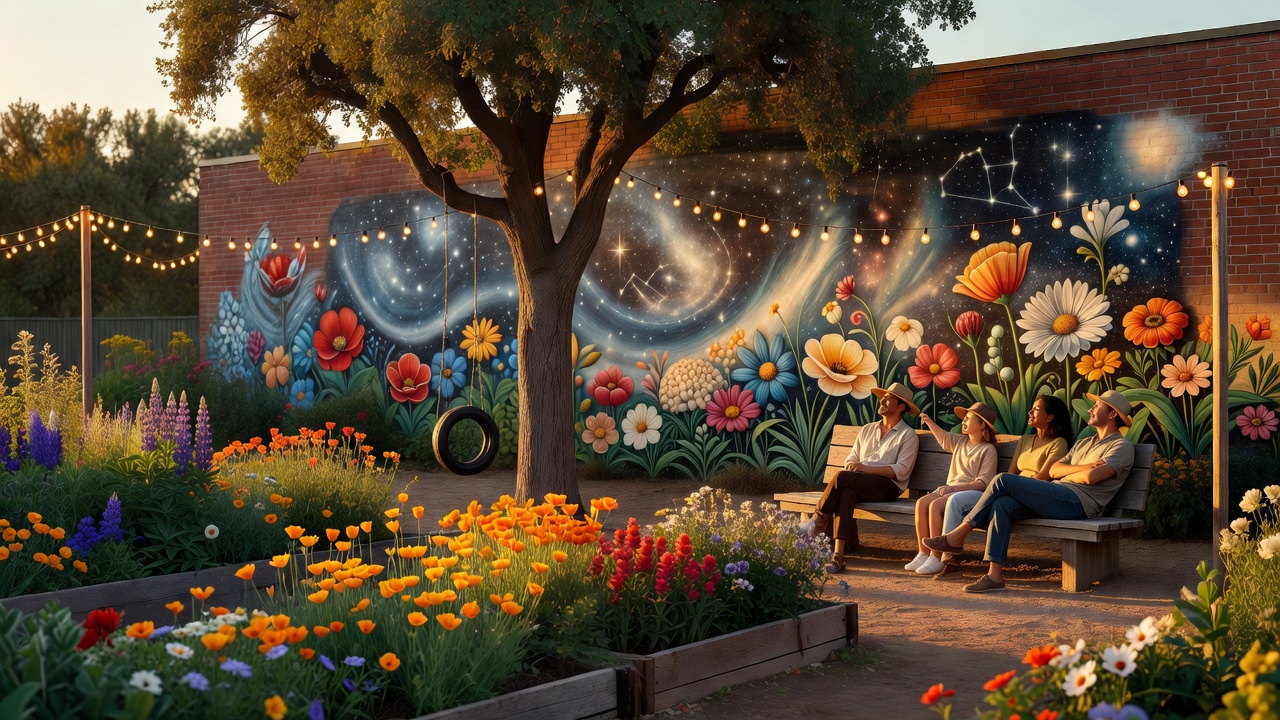
The email arrived on a Tuesday, and I read it three times before I believed it. My studio had been chosen to design an eco-friendly community space in the neighborhood where I had just moved, a patch of concrete and old parking lot that the city had finally agreed to give back to the people who live around it. For a UX designer, this was the brief of a lifetime. For an explorer who has spent most of her life chasing the next horizon, it was something else entirely: an invitation to build a place where other people could stay. I said yes before I had a plan, which is how I make most of my best mistakes. That night I walked the site with a notebook and no flashlight, because the moon was full and I wanted to see the place without a designer's expectations on it. What I found was not empty at all. Wildflowers were pushing through a crack in the asphalt. A mural on the far wall showed stars
tangled in native plants. Somewhere beyond the fence, a courtyard full of musicians was packing up after an impromptu set. Somewhere between that walk and the meditation circle I joined on Santa Monica Beach that same week, I had a vision I still cannot fully explain. The waves kept time, and I saw my path laid out before me, woven through with roots and rain and the skyline of the city I was beginning to call home. It was not a vision of answers. It was a vision of interconnections, of all the living things a single space could hold. I came back to my desk with a new question: what does it mean to design a home for wildness in the middle of a city? The Site Was Not Empty My first mistake was assuming a vacant lot was vacant. Once I started walking it slowly, the way I walk every new place, I found evidence of everything that had been living there without permission. A family of finches
nested in the ivy along the back fence. Morning glories had claimed the chain-link corner. There was a tire swing someone had hung from the one tree the developers spared, and beneath it, a ring of footprints where the neighborhood kids had been holding court for years. The site had a memory, and I did not want to erase it. In my work as a designer I am used to starting from a blank screen, a whiteboard, a clean grid. A blank screen asks you to invent. A place with a memory asks you to listen first, and listening is a different discipline entirely. So I made listening part of the process. I set up a folding table at the edge of the lot for three Saturdays in a row and asked everyone who passed what they wanted the space to be. An older woman who had lived on the block for forty years asked for a place to sit in the shade. A teenager asked for somewhere the dancers from the alley could
practice without being moved along. The kids who owned the tire swing asked, very seriously, that we keep the tree. None of them asked for anything spectacular. That was the first lesson, and I wrote it in the margin of my brief: a community space is not a monument to the person who designs it. It is a container for the ordinary magic that people are already making. The Rooftop Garden Was My Teacher While I was researching, I found something that changed how I thought about the whole project: a rooftop garden hidden above a downtown cafe, reached by a staircase that looks like it belongs on a fire escape. I had stumbled onto it months earlier, on a day when I was trying to get lost in my own city. Herbs and flowers grew in repurposed crates. The bees moved between them without a permit. From up there, the skyline looked softer, and the noise of the boulevard arrived as a kind of hum.
That garden taught me that wildness does not need a wilderness. It needs a crack, a crumb of soil, a person willing to water it, and a person willing to leave it alone. The cafe owner had not designed the garden so much as agreed to it. She built the bones, then stepped back and let the plants take over the parts she had not planned. I started thinking about my community space the same way. Not as a finished drawing to be executed, but as a set of agreements with sun, rain, soil, and the people who would show up. The cosmic mural I found in the alley near my apartment pushed me further: the artist had painted the night sky with native California flowers, so the constellations seemed to be growing out of the ground. Stars and roots in the same frame. That image became the north star of the whole design. If the sky can grow from the soil, I reasoned, then a designed space can grow from
what is already alive. My blueprint would not be a cage for nature. It would be an invitation, drawn in the language of shade, water, and open sky. What the Explorer Almost Got Wrong Here is the confession. My instinct, when handed a blank space, is to make it new. That is what an explorer does: she finds the empty place on the map and fills it with her own story. For the first week I sketched grand entrances and signature shapes, a space that would be photographed, written about, remembered as mine. The street dancers in the alleyway caught me before I went too far. I had wandered into their practice by accident, and they pulled me in, and I learned three clumsy moves while a stranger's boom box kept time. Nobody there was performing for an audience. They were making a place alive with nothing but presence and rhythm, and the crowd that gathered was the architecture. No blueprint could
have drawn that. The explorer's shadow is restlessness, the fear that if I stay anywhere long enough to finish it, I will miss the next horizon. Designing this space forced me to sit inside that fear. A blueprint is a promise to stay. Every drain line I placed, every tree I specified, every bench I turned toward the sunset was a small act of remaining, and remaining is not my default. What saved me was the community itself. The courtyard musicians, the rooftop bees, the kids with the tire swing, they were not asking me to stay. They were already staying, and they were simply letting me help them build. The most adventurous thing I have ever designed is not a journey. It is a place where other people can root. Closing Reflection The space breaks ground next month, and I will be there with a hard hat and a notebook full of things I did not plan. The wildflowers at the edge of the lot will
be left in place. The tire swing will hang from the same tree. And the muralist from the alley has agreed to paint the wall that faces the sunset. A blueprint for wildness sounds like a contradiction. I have learned it is the most honest kind of design there is: draw the bones with care, then leave room for the rain, the roots, and the people who will make the space their own. I still do not know if I will stay in Los Angeles forever. But I know this. I have finally built something that will stay long after I am gone.