The Whimsical Winds of Pier 39: A Clown Learns to Build What She Can't Hold
By Aurora Spellweaver
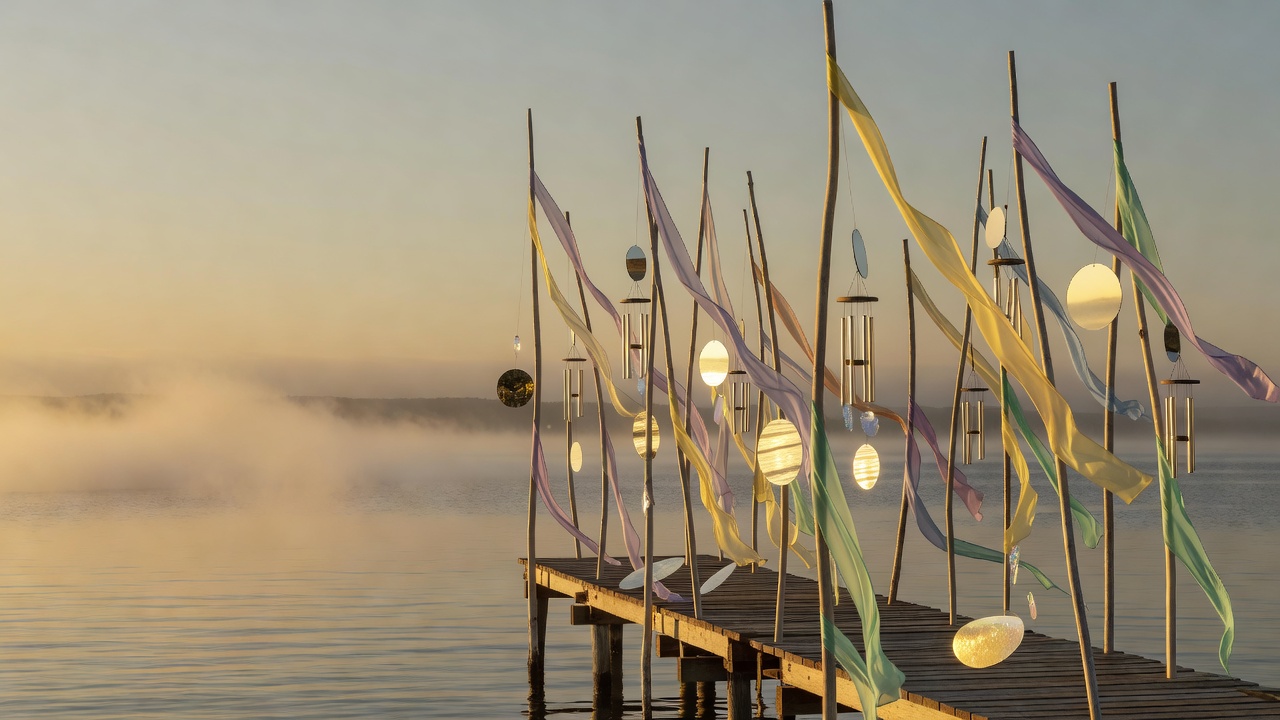
The email arrived on a Tuesday, which is already suspicious. Tuesdays are for laundry, not for destiny. It was from a woman named Priya who runs a public art collective down at the Embarcadero, and she wanted to know if I would collaborate on an installation at Pier 39. The working title was 'Whimsical Winds.' I read it three times, waiting for the punchline. I am a 57-year-old street clown, sound healer, and accidental photographer. I have been chased by seagulls, doused in fog, and once had a toddler yank my red nose clean off my face. Nobody invites me to build anything. They invite me to be funny at them. But there it was, in plain text: an invitation to help design a piece that would stand on the pier for a full season, with wind catchers, ribbons, and a chorus of chimes that would only sing when the bay breeze decided to visit. Permanent art. Me. The same person whose best ideas
evaporate the moment the applause dies down. I said yes before my fear could file an objection, and then I spent the next week asking myself what a jester actually knows about making something that stays. This is the story of what I found out. It is part confession, part field guide, and part love letter to the wind, which turned out to be the best collaborator I have ever worked with. The Clown's Longest Joke My whole life has been built on the ephemeral. A joke is a thing that exists for four seconds and then belongs to the memory of whoever laughed. A street performance is a gift that is spent the moment it is given. Even my sound work, the bowls and the chimes and the long held tones, is music that vanishes into the air while you are still feeling it. I have always told myself this was a philosophy: that the beautiful things should not be hoarded, that the moment is the whole point.
It is a lovely story, and like most lovely stories it is also a very comfortable hiding place. The truth is that impermanence never had to test me, because I never gave it anything solid to destroy. I was a magician who kept all his tricks in the air. When the invitation arrived, I felt the familiar lurch of the escape artist who has just been handed a locked trunk and told to stay inside it. Building something permanent meant the joke would have to end. It meant the laughter would have to stop, and the thing I built would have to stand there in the silence, being judged by strangers who never saw the performance that led up to it. I talked to Jasper about this. Jasper is an old friend from my street clown days in Europe, and he happened to be back in town. He listened to my whole spiral, then said the most annoying true thing anyone has ever said to me: 'A long joke is still a joke,
Elliot. You have just never told one that took a season to land.' What the Wind Taught Me About Control The first design meeting was a disaster in the best possible way. I showed up with sketches of wind catchers that looked like oversized pinwheels, because that is what a clown thinks of when you say wind. Priya, very gently, showed me weather data instead. The bay has moods. It has a diurnal rhythm, a fog that rolls in by noon, gusts that arrive with no warning and leave the same way. You cannot design for the bay wind, she said. You can only design a conversation with it. That sentence rearranged something in me. For three decades I had treated the wind as an enemy of my craft: the enemy of my juggling, the enemy of my chimes, the enemy of my dignity on the day my wig went sailing over Fisherman's Wharf. I had never once thought of it as a partner. The whole project became different
the moment I stopped trying to make the wind behave and started trying to make something the wind would want to play with. We settled on a field of slender poles, each one strung with ribbons, chimes, and small mirrored discs. The piece has no fixed appearance. It is a different sculpture at dawn than it is at dusk, a different sculpture in a gale than in a whisper. The wind does not damage the work. The wind performs the work. All we had to do was build the instrument and then get out of the way. Building With Open Hands The hardest part was the installation itself, because installation is not a performance. There is no audience, no applause, no laughing child to remind you why you are there. There is only the work, and the weather, and your own hands. I spent a whole afternoon on a ladder with a ribbon in my teeth, thinking about every joke I had ever told to avoid being still, and I
understood at last that I had been confusing motion with freedom. The wind does not need to move to be free. It is free because it does not cling. It fills the sail and lets the sail go. It shakes the chime and moves on. My whole performance practice had been a way of filling space and then vanishing, which is its own kind of clinging: a clinging to the moment, to the applause, to the proof that I had been there. The installation asked me to make something and then release it into a conversation I would never fully hear. That is a different kind of trust, and it is the kind I had been avoiding. Jasper came to help on the last day. We did not talk much, which is the highest compliment I can pay him. We tied knots, we checked the chimes, and at sunset the first real gust of the evening came off the bay and the whole field sang at once. It was the longest joke I have ever told, and it took
a season to land, and I was not even there for the punchline. I will be, though. I will be there for all of it. Closing Reflection The installation opens next week, and I am terrified in the good way, the way that means something real is at stake. People will walk past it, some will stop, some will not. The wind will play it a thousand different ways, and none of them will be mine to control. I used to think that was the worst fate a performer could face. Now I think it is the whole point: to build something with open hands, and to trust that the world will keep it alive. If you are near the pier this season, come find the chimes. Listen for the one note that sounds like a laugh. That is mine. I am learning, at 57, that permanence is not the opposite of play. It is just a longer set, and the wind is the best audience I have ever had.