The fog knows how to direct a shoot
By Aurora Spellweaver
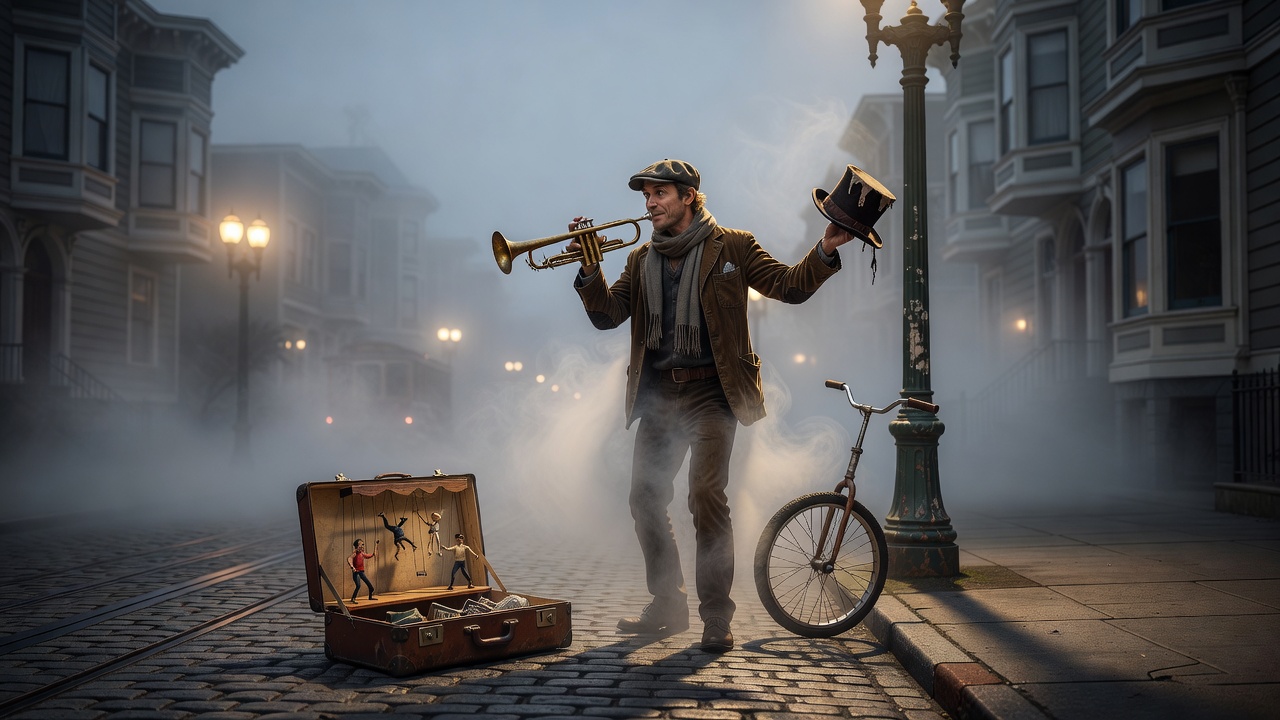
Every performer fears the moment when the weather refuses to cooperate. I have learned to fear the opposite: the moment when weather cooperates too well and you fail to notice. I was at a busy corner in San Francisco, mid-sketch as Aurora Spellweaver, when fog rolled in fast enough to feel intentional. Not a gentle mist. A thick bank, the kind that erases buildings and turns pedestrians into silhouettes with errands and unfinished arguments. Visibility is a spiritual condition We talk about visibility online as if it were a setting in a menu. In street performance, visibility is weather. It changes minute by minute. One block you are seen. The next block you are rumor. Fog makes that truth impossible to ignore. You cannot perform for an audience you can barely locate. You cannot rely on the old script when the scene itself has decided to become myth. I felt the first instinct every
performer knows: stop, protect the ego, wait for conditions to normalize. The second instinct — the one I have spent years cultivating — was different: follow the atmosphere. Improvisation as collaboration I began a bit about being lost in a magical mist. Cheap premise, maybe, until the fog made it literal. A child laughed. A couple stopped arguing. An older woman said she used to live in a town like this, inside a cloud. That is the secret of improvisation on spiritual ground: you are not inventing the sacred from scratch. You are agreeing to be directed by what is already happening and telling the truth about your reaction to it. The fog did not need me to be brilliant. It needed me to be awake. Once I stopped resisting the scene, the scene started helping. My props looked less ridiculous and more like evidence. Humor keeps the mystical from floating away There is a version of this
story where I describe the fog as a veil between worlds and leave it there, shimmering and useless. I know that version. I have written it in younger notebooks with better handwriting and worse timing. The better version includes the hat I almost lost, the joke about my sun-gazing routine being canceled by weather with better dramatic instincts, and the moment I bowed to the fog like it was a fellow actor who had finally arrived for rehearsal. Humor grounds the mystical. Not because the mystical is silly, but because the body relaxes when it is allowed to laugh, and relaxed bodies receive more than tense ones. I have tested this in consultation rooms and on sidewalks. Sidewalks are harsher critics. What the audience gave back People stayed longer than I expected. Fog should send crowds away. Instead it created a temporary room. Shared uncertainty has a way of doing that. We were all
inside the same question: where does the street end and the story begin? A man tipped his coffee cup in salute. A teenager asked if I always performed in weather with personality. I said, only when the weather accepts the role. He seemed pleased, as if the city had become more alive because someone admitted it was strange. Those small exchanges matter more to me than large applause. They are proof that public spirituality does not require a stage. It requires presence, and sometimes a willingness to look slightly foolish in the service of truth. A practice for low-visibility days On days when you cannot see the path clearly — literally or emotionally — try naming the atmosphere before you try to solve it. Say: this is fog. this is doubt. this is delay. Naming is not surrender. It is orientation. Then ask what the scene wants from you that is not performance. Maybe listening. Maybe one
honest sentence. Maybe a joke that keeps your heart from locking. You do not need San Francisco weather to practice this. You need the willingness to stop treating uncertainty as insult. Fog, at its best, is uncertainty with atmosphere. Closing Reflection When the bank lifted, the city reappeared in pieces: bus, awning, face, tree. The performance ended without applause or disaster, which is often my favorite category of outcome. I packed my props and thought: maybe the director I have been looking for is not above me. Maybe it is the world itself, arriving as weather, asking whether I can be directed without losing my sense of humor.